icon New mining location added: Finland More information

Everything You Need to Know About Bitcoin in 2026

No jargon. No hype. Just a clear, factual breakdown of what Bitcoin is, how it works, why it has value, and why 2026 matters.

What Is Bitcoin, Actually?

Bitcoin is digital money with a fixed supply. There will only ever be 21 million Bitcoin. No government, company, or individual can create more. It runs on a global network of computers that anyone can join. No single entity controls it.

Transactions are verified by miners, who use specialized hardware to process and secure the network. In return for this work, miners receive newly created Bitcoin as a reward. This is how new Bitcoin enters circulation.

Bitcoin can be sent to anyone, anywhere in the world, in minutes. There is no bank approval needed, no wire transfer delay, and no border restriction. It works 24 hours a day, 365 days a year.

Why Does Bitcoin Have Value?

Bitcoin has value for the same reason gold has value: scarcity, durability, divisibility, portability, and resistance to counterfeiting. But Bitcoin improves on gold in nearly every category.

Gold is scarce, but new deposits are discovered regularly and mining output can increase. Bitcoin’s supply is mathematically fixed. Gold is portable but heavy. Bitcoin can be sent across the world in minutes from a phone. Gold can be counterfeited. Bitcoin cannot.

The market currently values Bitcoin at a market capitalization of over $1.5 trillion, making it one of the top 10 most valuable assets on earth. Institutional adoption from BlackRock, Fidelity, and sovereign nations continues to accelerate. Bitcoin is the only asset no government can touch.

How Does Bitcoin Work?

Bitcoin runs on a technology called a blockchain, which is a public ledger that records every transaction ever made. Think of it as a spreadsheet that everyone can see, but no one can edit retroactively.

New transactions are grouped into blocks. Miners compete to solve a mathematical puzzle that validates the block. The first miner to solve it adds the block to the chain and earns the block reward. This process is called proof of work.

The difficulty of the puzzle adjusts automatically to ensure that one block is produced approximately every 10 minutes, regardless of how many miners are on the network. This self regulating mechanism is what makes Bitcoin antifragile.

Why 2026 Matters

The 2024 halving cut the mining reward from 6.25 to 3.125 BTC per block. Historically, the 12 to 24 months following a halving produce the strongest returns in Bitcoin’s cycle. That places 2025 and 2026 squarely in the window.

Spot Bitcoin ETFs launched in January 2024 and have attracted tens of billions in institutional capital. Governments are establishing strategic Bitcoin reserves. The infrastructure for mass adoption is being built in real time.

Whether you are considering buying Bitcoin or producing it through mining, 2026 is a pivotal year. The convergence of reduced supply, increasing demand, and institutional adoption creates a setup that has historically delivered outsized returns.

21 Million
the total number of Bitcoin that will ever exist. Fixed forever. No exceptions.

Frequently Asked Questions

What is Bitcoin in simple terms?

Bitcoin is digital money with a fixed supply of 21 million coins. It runs on a global network of computers. No one controls it. You can send it to anyone, anywhere, without a bank. Its scarcity is enforced by mathematics, not politics.

Is Bitcoin real money?

Bitcoin is recognized as legal tender in El Salvador, accepted by thousands of businesses worldwide, and held as a reserve asset by major institutions and sovereign nations. It functions as money: it stores value, can be exchanged, and serves as a unit of account.

Why is Bitcoin’s price so volatile?

Bitcoin is still in its adoption phase, growing from a niche technology to a global asset class. As more institutions, nations, and individuals adopt Bitcoin, volatility is expected to decrease. Over any four year period, Bitcoin has historically trended strongly upward despite short term swings.

How is new Bitcoin created?

New Bitcoin is created through mining. Specialized computers solve mathematical puzzles to validate transactions. The miner who solves the puzzle first earns newly created Bitcoin. The reward is currently 3.125 BTC per block and is cut in half every four years.

Is it too late to buy Bitcoin?

Bitcoin’s market cap is still a fraction of gold, real estate, or global equities. If Bitcoin captures even a small percentage of these markets, significant upside remains. People have asked this question at every price point from $1 to $80,000, and it has always been early so far.

Keep Reading

Last updated: 2026-04-12

Hosted Mining: The Unfair Advantage for New Miners

You get institutional electricity rates, professional maintenance, industrial cooling, and 24/7 monitoring. You own the machine. You keep every satoshi it produces.

What Is Hosted Mining?

Hosted mining means your Bitcoin miner lives in a professional facility instead of your home. The facility provides cheap electricity (typically 6 to 7 cents per kWh), industrial cooling, 24/7 monitoring, and maintenance. You own the machine outright and all mined Bitcoin goes directly to your wallet.

Think of it like owning a rental unit in a professionally managed building. You own the asset. The management company handles operations. You collect the returns.

This model has become the dominant way for individuals to mine Bitcoin because it solves every major problem with home mining: noise, heat, high electricity costs, and maintenance complexity.

The Economics of Hosted Mining

At a hosted facility paying $0.065 to $0.065 per kWh, your monthly electricity cost for a modern ASIC is roughly $100 to $130. At home rates of $0.12 to $0.15, that same machine costs $300 to $380 per month in electricity.

The cost difference is $200+ per month. Over a machine’s 3 to 5 year lifespan, that adds up to $7,200 to $12,000 in additional profit compared to home mining. The hosting fee is typically included in the per kWh rate, so what you see is what you pay.

At current Bitcoin prices, a hosted machine produces $300+ in monthly profit after all costs. ROI on the machine itself takes 8 to 14 months. Everything after that is net profit in your wallet.

What Hosting Includes

Electricity at institutional rates negotiated directly with power generators. Industrial air or immersion cooling that maintains optimal machine temperatures. 24/7 facility monitoring with automatic restart if your machine goes offline.

Regular maintenance including fan replacement, dust cleaning, and firmware updates. Secure facility with controlled access, fire suppression, and insurance. A monitoring dashboard so you can check your machine’s performance from anywhere.

Some providers also handle mining pool setup, Bitcoin wallet configuration, and machine procurement. Full service hosting means you can go from zero knowledge to producing Bitcoin without touching the hardware.

How to Choose a Hosting Provider

Not all hosting providers are equal. The key questions to ask: What is the all in electricity rate? (Should be under $0.065/kWh.) What is the guaranteed uptime? (Should be 95%+.) Where is the facility located? What is their cooling method? Do you own the machine or are you renting hashrate? (Own, always.)

Avoid providers that only offer cloud mining or hashrate contracts. These are often overpriced or outright scams. Real hosted mining means you own the physical machine and can verify its existence.

Epic Mining offers hosted mining with institutional rates, full machine ownership, and professional facility management.

$0.065/kWh
hosted mining rate vs $0.12+ residential. That 8 cent difference is $200+ per month in your pocket.

Frequently Asked Questions

What is hosted Bitcoin mining?

Hosted mining means your mining machine operates in a professional facility. The facility provides cheap electricity, cooling, and maintenance. You own the machine and receive all mined Bitcoin directly to your wallet.

How much does hosted mining cost?

Hosting fees are typically expressed as an all in electricity rate of $0.065 to $0.065 per kWh. For a standard ASIC, that translates to roughly $100 to $160 per month, which is 2 to 3 times cheaper than running the same machine at home.

Is hosted mining safe?

Yes, when you choose a reputable provider. Key indicators: you own the physical machine (not hashrate contracts), the facility has documented security, they provide a monitoring dashboard, and they have verifiable testimonials or track record.

Can I visit my hosted mining machine?

Most reputable hosting providers allow facility visits by appointment. This is a good way to verify the operation is legitimate and well run. If a provider refuses visits, that is a red flag.

Keep Reading

Last updated: 2026-04-12

How a Machine Turns Electricity Into Money

A specialized computer plugs into a wall, connects to the internet, and starts producing Bitcoin 24 hours a day. Here is exactly how that process works.

The Simplest Explanation

A Bitcoin miner is a computer designed to do one thing: solve mathematical puzzles as fast as possible. Every time the network of miners collectively solves a puzzle, a new block of Bitcoin transactions is confirmed and the miner that contributed the winning solution earns newly created Bitcoin.

Think of it like a digital lottery that runs every 10 minutes. Your miner buys trillions of “tickets” per second. The more computing power you have, the more tickets you hold, and the more Bitcoin you earn. Your only ongoing cost is electricity.

That is the entire business model. You plug in a machine, it consumes electricity, and it produces Bitcoin. Every hour of every day. No customers to chase. No inventory to manage. No employees to hire. Just a machine, an outlet, and an internet connection.

What Is an ASIC Miner?

ASIC stands for Application Specific Integrated Circuit. Unlike a regular computer that can run spreadsheets, browse the web, and play games, an ASIC is built to do exactly one thing: mine Bitcoin. It does this single task thousands of times more efficiently than any general purpose computer.

A modern ASIC miner like the Antminer S21 produces roughly 200 terahashes per second (TH/s) while consuming about 3,500 watts of power. It runs 24 hours a day, 7 days a week, producing Bitcoin continuously.

The machines are roughly the size of a large shoebox, weigh about 30 pounds, and produce significant noise (around 75 decibels, similar to a vacuum cleaner running constantly). They also produce substantial heat, which is why professional mining operations use industrial cooling systems.

How Mining Actually Works: Step by Step

Step 1: Your miner connects to a mining pool, which is a group of miners that combine their computing power and share rewards proportionally. Solo mining is possible but impractical for most people because the odds of solving a block alone are extremely low.

Step 2: The mining pool assigns work to your machine. Your ASIC begins guessing solutions to the current block’s mathematical puzzle at a rate of trillions of guesses per second.

Step 3: When the pool collectively solves a block (roughly every 10 minutes on the network), the 3.125 BTC block reward plus transaction fees are distributed among all miners in the pool based on how much computing power each contributed.

Step 4: Your share of the reward is deposited directly into your Bitcoin wallet. This happens automatically, continuously, around the clock.

The Economics: Input vs Output

The entire economics of mining comes down to one calculation: does the value of Bitcoin you produce exceed the cost of the electricity consumed? At 6 to 7 cents per kWh, the answer has been yes for the entire history of Bitcoin mining with current generation hardware.

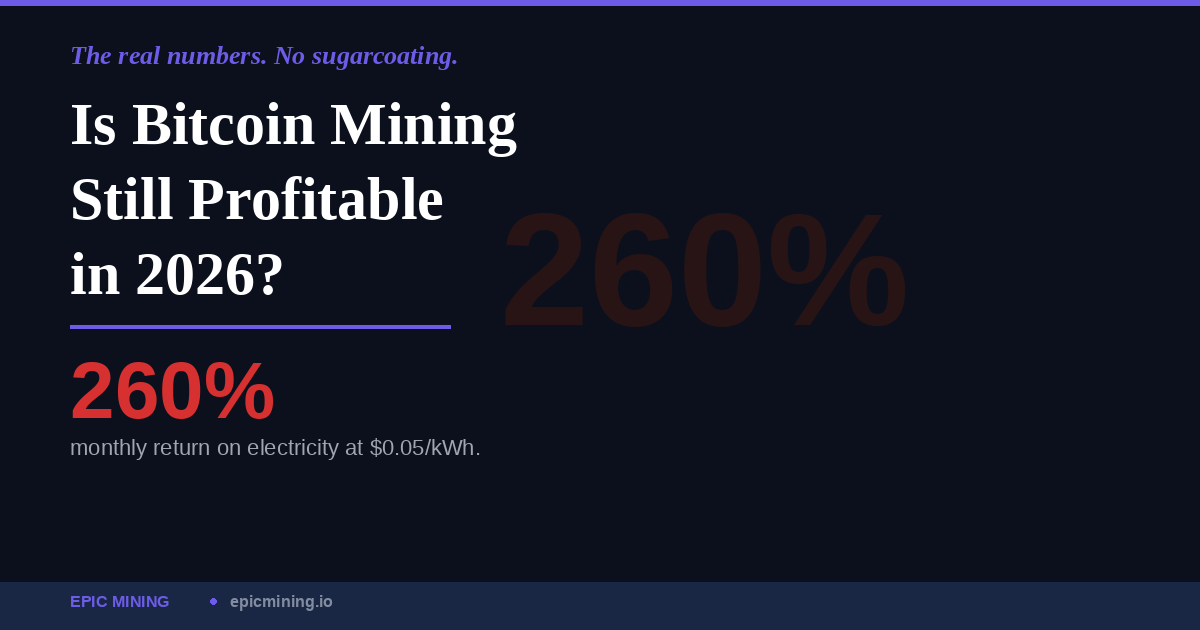
A single modern ASIC running at $0.065/kWh costs approximately $125 per month in electricity and produces roughly $450 worth of Bitcoin at current prices. That is a ~260% monthly return on your electricity cost. The hardware pays for itself in 8 to 14 months, then continues producing for 3 to 5 years.

This is the fundamental reason why producing Bitcoin beats buying it. You are manufacturing an asset at a fraction of its market value.

Getting Started Without the Complexity

You do not need to understand the technical details of hashing algorithms or block propagation to mine Bitcoin profitably. Hosted mining handles all the technical complexity for you.

You purchase a mining machine. It gets installed in a professional facility with cheap power and industrial cooling. The facility handles maintenance, monitoring, and uptime. Bitcoin is deposited directly into your wallet.

You can go from zero to mining in about 7 days. No technical background required. Just a decision to start producing Bitcoin instead of only buying it.

3.125 BTC
the current block reward, split among miners approximately every 10 minutes, 24 hours a day

Frequently Asked Questions

What does a Bitcoin miner actually do?

A Bitcoin miner is a specialized computer that solves mathematical puzzles to validate Bitcoin transactions. For this work, it earns newly created Bitcoin. It runs 24/7 and produces Bitcoin continuously as long as it has power and an internet connection.

How much electricity does a Bitcoin miner use?

A modern ASIC miner consumes approximately 3,000 to 3,500 watts continuously. That translates to roughly $100 to $130 per month at 6 to 7 cents per kWh. The Bitcoin produced is typically worth 3 to 4 times the electricity cost at competitive power rates.

How much Bitcoin can one miner produce?

A current generation miner (like the Antminer S21) produces approximately 0.0057 BTC per month at current network difficulty. At $80,000 per Bitcoin, that is roughly $450 per month in revenue from a single machine.

Do I need technical knowledge to mine Bitcoin?

No. Hosted mining providers handle all technical aspects including installation, power, cooling, and maintenance. You purchase the machine, it gets set up in a facility, and Bitcoin is deposited to your wallet automatically. No technical background is needed.

What is a mining pool?

A mining pool is a group of miners that combine their computing power and share Bitcoin rewards proportionally. Joining a pool provides consistent, smaller payouts rather than infrequent large payouts. Nearly all individual miners use pools.

Keep Reading

Last updated: 2026-04-12

The Only Asset No Government Can Touch

Bank accounts can be frozen overnight. Gold has been confiscated before. Real estate can be taxed into the ground. Bitcoin operates outside every one of these systems.

Every Traditional Asset Has a Kill Switch

In 2013, the government of Cyprus seized up to 47.5% of bank deposits over 100,000 euros to bail out its banking system. In 1933, the United States made it illegal for citizens to own gold, forcing them to sell at a government mandated price. In 2022, Canada froze the bank accounts of citizens who donated to a protest movement.

Every traditional asset you own exists within a system that someone else controls. Your bank account can be frozen with a court order. Your brokerage account can be restricted. Your real estate can be subjected to property taxes, eminent domain, or capital controls.

These are not theoretical risks. They have happened in developed nations within living memory. The common thread is simple: if someone else has a key to your asset, they can lock you out.

Why Bitcoin Is Different

Bitcoin is the first asset in human history that can be held without relying on any third party. No bank, no government, no corporation stands between you and your Bitcoin. If you hold your own keys, no one on earth can freeze, seize, or confiscate your Bitcoin without your cooperation.

This is not a feature that was added later. It is the foundational design principle. Satoshi Nakamoto built Bitcoin specifically to operate outside the control of any single authority. The network runs on tens of thousands of computers across every continent. There is no CEO to subpoena, no server to shut down, no board of directors to pressure.

The supply is fixed at 21 million coins. No government can print more. No emergency can justify expanding the supply. The rules are enforced by math, not politics.

Self Custody: What It Means to Actually Own Something

When you keep Bitcoin on an exchange, you do not actually own it. The exchange owns it. You have an IOU. This is no different from a bank account. If the exchange fails, your Bitcoin is gone. FTX proved this in spectacular fashion.

Self custody means holding your own private keys. A hardware wallet, a seed phrase stored offline, or a multisignature setup. When you self custody Bitcoin, the only way someone can take it is if you hand over the keys yourself.

This is what makes Bitcoin fundamentally different from every other store of value in history. Gold can be confiscated. Real estate can be seized. Cash can be frozen. Bitcoin, properly self custodied, cannot be taken without your consent.

The Case for Sovereign Wealth

In an era of expanding government debt, increasing financial surveillance, and currency devaluation, having assets beyond the reach of any single authority is not paranoia. It is prudence.

You do not have to move your entire net worth into Bitcoin. But having some portion of your wealth in an asset that no central bank can dilute, no government can freeze, and no institution can seize is a rational hedge against an increasingly uncertain financial landscape.

Mining Bitcoin lets you acquire this sovereign asset at below market cost. Hosted mining means you do not need to manage any hardware. You own the machine, you produce the Bitcoin, you hold the keys.

21 Million
the fixed, unchangeable total supply of Bitcoin. No central bank, government, or emergency can create one more.

Frequently Asked Questions

Can the government confiscate Bitcoin?

If you self custody your Bitcoin using a hardware wallet or multisignature setup, no government can seize it without your cooperation. Unlike bank accounts, which can be frozen with a court order, Bitcoin held with your own private keys is accessible only to you.

What is self custody?

Self custody means holding your own Bitcoin private keys rather than trusting an exchange or third party. You use a hardware wallet or seed phrase stored offline. Only you can authorize transactions. This eliminates counterparty risk entirely.

Has any government ever seized citizens’ assets?

Yes. Cyprus seized bank deposits in 2013. The US banned private gold ownership in 1933. Canada froze bank accounts of protest donors in 2022. India demonetized 86% of its currency overnight in 2016. Asset seizure by governments is not theoretical. It is historical fact.

Is Bitcoin really beyond government control?

Bitcoin’s network runs on tens of thousands of computers across every country on earth. There is no central server, no CEO, and no single point of control. While governments can regulate exchanges and on ramps, they cannot shut down the Bitcoin network or confiscate properly self custodied Bitcoin.

How do I get started with Bitcoin self custody?

Start with a reputable hardware wallet from manufacturers like Ledger, Trezor, or Coldcard. Write down your seed phrase on paper or metal. Never store it digitally. For larger holdings, consider a multisignature setup that requires multiple keys to authorize transactions.

Keep Reading

Last updated: 2026-04-12

Is Bitcoin Mining Still Profitable in 2026?

Not theory. Not projections. Real profitability numbers from machines running right now in 2026. Here is what the data says.

The Short Answer: Yes, If You Do It Right

Bitcoin mining is profitable in 2026 for operators running current generation hardware at electricity rates below 7 cents per kWh. At 6 to 7 cents per kWh, which hosted facilities typically offer, a single ASIC miner generates roughly $300 to $350 in monthly profit after electricity costs.

The key variables are your electricity rate, your hardware efficiency, and the current Bitcoin price. All three are in favorable territory right now. The post halving cycle historically delivers rising Bitcoin prices, which directly increases mining revenue.

Miners who lose money in 2026 almost always share one of two problems: they pay too much for electricity or they run outdated hardware. Get those two variables right and the math works.

The Profitability Math

Metric At $0.065/kWh At $0.065/kWh At $0.07/kWh
Monthly Revenue $456 $456 $456
Monthly Electricity $100 $126 $176
Monthly Profit $356 $330 $280
Profit Margin 78% 72% 61%
Annual Profit $4,272 $3,960 $3,360
ROI (on $5,000 machine) 14 months 15 months 18 months

These numbers assume a current generation ASIC (200 TH/s, 3,500W) and current network difficulty. Revenue fluctuates with Bitcoin price and difficulty adjustments. At competitive power rates, the margin is substantial.

Hardware ROI: How Long Until You Break Even?

A new ASIC miner costs between $3,000 and $8,000 depending on the model and market conditions. At current profitability levels, most machines reach full ROI within 8 to 14 months.

After payback, the machine continues producing Bitcoin for another 2 to 4 years. That is years of pure profit beyond your initial investment. The machines also have resale value, especially during bull market periods when demand for hashrate spikes.

Hardware ROI is the single most important metric in mining. If a machine pays for itself in under 12 months, everything after that is gravy.

What Separates Winners from Losers

The #1 factor is electricity cost. A miner paying $0.065/kWh makes over $300/month profit. The same miner at $0.12/kWh is losing money. This is why hosted mining exists. It gives individual miners access to electricity rates they could never get at home.

The #2 factor is hardware generation. Running a 3 year old miner that does 80 TH/s at 3,400W is a losing proposition at any power rate. Current generation machines (180 to 200+ TH/s) at lower wattage are the only ones worth operating.

The #3 factor is uptime. A machine that runs 98% of the time produces 20% more Bitcoin over a year than one running 82% of the time. Professional facilities deliver 95%+ uptime. Home mining struggles to match that.

The Bottom Line

Yes, Bitcoin mining is profitable in 2026. But only if you run efficient hardware at competitive power rates with high uptime. Hosted mining checks all three boxes without requiring you to build or manage anything.

The halving cycle and rising Bitcoin price create a tailwind for miners right now. The window to start producing Bitcoin at these economics will not last forever. As more miners come online and difficulty increases, margins compress.

$300+
monthly profit per miner at competitive electricity rates in 2026

Frequently Asked Questions

Is Bitcoin mining profitable in 2026?

Yes. At electricity rates of 4 to 7 cents per kWh with current generation hardware, a single miner produces $280 to $356 in monthly profit. The key factors are cheap electricity, efficient hardware, and high uptime.

How much does a Bitcoin miner make per month?

A current generation ASIC miner generates approximately $456 in monthly revenue at current Bitcoin prices. After electricity costs of $100 to $176 (depending on your rate), monthly profit ranges from $280 to $356.

How long until a Bitcoin miner pays for itself?

At current profitability levels, most miners reach ROI in 8 to 18 months depending on the machine cost and electricity rate. After payback, the machine continues producing Bitcoin for 2 to 4 additional years.

What is the biggest risk in Bitcoin mining?

The biggest risk is a sustained drop in Bitcoin price combined with rising network difficulty. If Bitcoin drops 50% while your electricity costs stay the same, margins compress dramatically. This risk is mitigated by running efficient hardware at the lowest possible power rate.

Keep Reading

Last updated: 2026-04-12

Your Financial Advisor Won’t Tell You This

The one asset class that outperformed everything in the last 15 years never made it into your portfolio. There is a reason for that.

The Asset Your Advisor Ignores

If your financial advisor managed $100,000 for you in 2015, they probably put you in a mix of stocks, bonds, and maybe some real estate. A good year returned 8% to 12%. Over a decade, that portfolio roughly doubled.

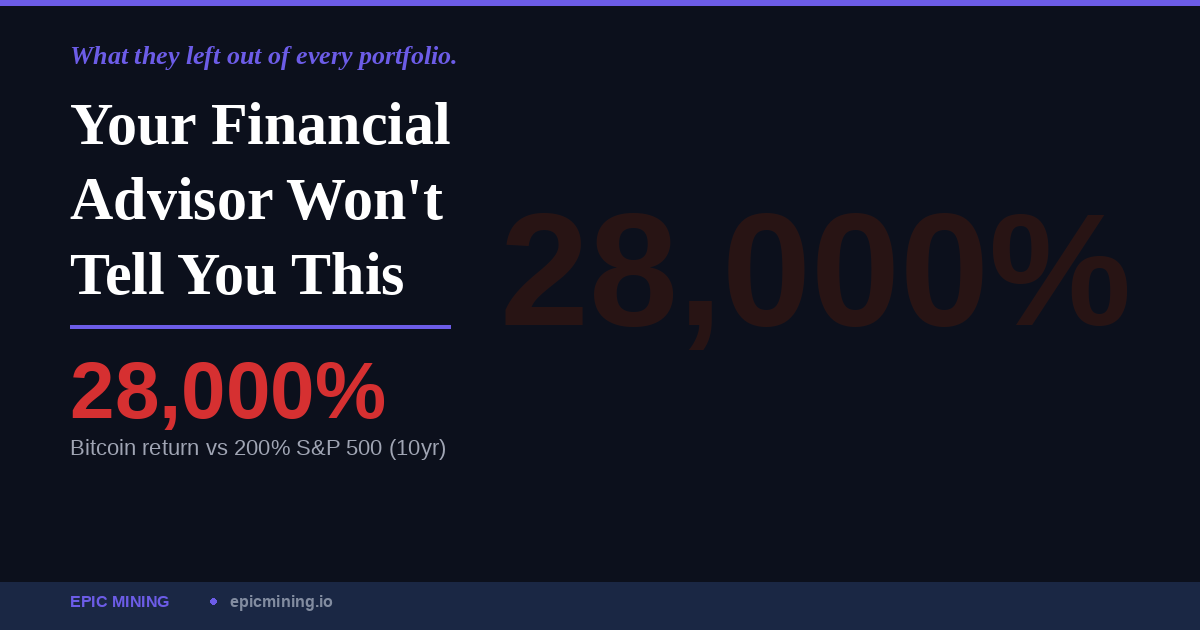
In the same period, Bitcoin went from $300 to over $80,000. That is a 26,000%+ return. It was the single best performing asset class of the last decade, and the decade before that. Yet most financial advisors never mentioned it, and still do not.

This is not because they are trying to protect you from risk. It is because their business model, their licensing, and their compliance structure do not accommodate Bitcoin. They cannot sell it, so they do not recommend it.

Why Traditional Finance Missed Bitcoin

Financial advisors earn commissions and management fees on the products they sell. Mutual funds, ETFs, annuities, insurance products. These are the tools they are trained on and compensated for.

Bitcoin does not fit into that model. There is no recurring management fee on a hardware wallet. There is no 1% annual advisory charge on self custodied BTC. When your advisor says “it is too risky,” what they often mean is “I cannot make money recommending it.”

The introduction of spot Bitcoin ETFs has started to change this, but most advisors still allocate 0% to Bitcoin. Meanwhile, Bitcoin keeps outperforming the portfolios they build.

The 60/40 Portfolio Is Broken

For decades, financial advisors recommended a 60% stocks and 40% bonds split. It was considered the gold standard of conservative investing. In the last five years, that model has been crushed.

Bonds lost significant value as interest rates rose. Stocks became increasingly concentrated in a handful of tech companies. The diversification that 60/40 was supposed to provide stopped working when both asset classes moved in the same direction.

Adding even a small Bitcoin allocation, just 2% to 5% of a portfolio, has historically improved risk adjusted returns. Multiple studies from Fidelity and ARK Invest have confirmed this. Your advisor likely knows this data exists. They just cannot act on it.

What Smart Money Is Actually Doing

While retail financial advisors tell clients to stay away from Bitcoin, the world’s largest institutions are buying it. BlackRock launched a Bitcoin ETF. Fidelity offers Bitcoin custody. MicroStrategy holds over 200,000 BTC on its balance sheet.

Nations are building strategic Bitcoin reserves. The smart money is not debating whether Bitcoin has value. They are debating how much to accumulate and how fast. The question is no longer “should I own Bitcoin” but “what is the best way to acquire it.”

One answer is producing it below market price through mining.

Producing Bitcoin Instead of Buying It

Your advisor will never suggest this: instead of buying Bitcoin at market price, you can produce it at a discount through mining.

A Bitcoin miner converts electricity into BTC 24 hours a day. At hosted facilities with institutional power rates, the cost to produce one Bitcoin is significantly below market price. You are not trading. You are manufacturing an asset at below retail cost.

This is how the largest Bitcoin holders in the world operate. They do not buy on exchanges. They mine.

26,000%+
Bitcoin’s return over the last decade vs ~200% for the S&P 500

Frequently Asked Questions

Why don’t financial advisors recommend Bitcoin?

Most advisors earn commissions and fees on traditional products like mutual funds, ETFs, and insurance. Bitcoin does not fit into their compensation model. They cannot charge a recurring management fee on self custodied Bitcoin, so they have little financial incentive to recommend it.

Is a 60/40 portfolio still a good strategy?

The traditional 60/40 stocks and bonds portfolio has underperformed in recent years. When interest rates rose, both stocks and bonds dropped simultaneously, breaking the diversification the model relies on. Multiple studies show that adding a small Bitcoin allocation of 2% to 5% improves risk adjusted returns.

How much Bitcoin should I have in my portfolio?

Research from Fidelity and ARK Invest suggests that a 2% to 5% Bitcoin allocation in a diversified portfolio has historically improved returns without significantly increasing risk. Some investors with higher risk tolerance allocate 10% or more. Your ideal allocation depends on your time horizon and goals.

Is it too late to invest in Bitcoin?

People have asked this question at every price point in Bitcoin’s history, from $1 to $80,000. Bitcoin’s market cap is still a fraction of gold, real estate, or global equities. If Bitcoin captures even a small percentage of these markets, the current price is still early.

Keep Reading

Last updated: 2026-04-12

How to Start Bitcoin Mining in 7 Days

This is the checklist. Follow it step by step and you will have a Bitcoin miner running and producing BTC within one week. No technical background needed.

Day 1 to 2: Decide Your Setup

You have two paths. Path A: Hosted mining (recommended for most people). You buy a machine and a hosting provider installs and manages it. No noise, no heat, institutional power rates. Path B: Home mining. You set up and run the machine yourself. Only practical if you have cheap electricity and a space that can handle 75 dB of constant noise.

For this guide, we will focus on Path A because it is the fastest, simplest, and most profitable path for most people. Contact a hosting provider, discuss machine options, and choose your miner.

Day 2 to 3: Purchase Your Miner

Choose a current generation ASIC. The Antminer S21 series and Whatsminer M60 series are the leading options in 2026. Budget $3,000 to $8,000 depending on the model.

Buy from your hosting provider (many offer packages) or from an authorized dealer. Verify the machine is new and comes with a manufacturer warranty. Pay and confirm delivery to the hosting facility.

Day 3 to 4: Set Up Your Bitcoin Wallet

You need a wallet to receive your mined Bitcoin. For long term holdings, use a hardware wallet (Ledger, Trezor, or Coldcard). For initial setup, a reputable software wallet like BlueWallet or Sparrow works fine.

Write down your seed phrase on paper. Store it in a secure location. Never share it with anyone. Never store it digitally. This seed phrase is the master key to your Bitcoin.

Day 4 to 5: Configure Your Mining Pool

Your hosting provider may handle this, but you will need to choose a mining pool. Major pools include Foundry USA, ViaBTC, F2Pool, and Antpool. Each has slightly different fee structures and payout methods.

Provide your pool information and wallet address to your hosting provider. They will configure the machine to mine to your pool and send rewards to your wallet.

Day 5 to 7: Machine Installation and First Bitcoin

The hosting facility receives your machine, inspects it, installs it in their facility, connects it to power and internet, and begins mining. You will receive a monitoring dashboard to track your machine’s performance.

Within 24 to 48 hours of installation, you will start seeing Bitcoin deposited into your wallet. That is it. You are now a Bitcoin miner producing BTC 24 hours a day.

From here, your job is simple: monitor your machine’s uptime and revenue, decide on your accumulation or selling strategy, and let the machine do its work.

7 Days
from first contact to first Bitcoin in your wallet. That is all it takes to start producing.

Frequently Asked Questions

How much does it cost to start Bitcoin mining?

A new ASIC miner costs $3,000 to $8,000. First month hosting is typically $100 to $200. Total startup cost ranges from roughly $3,500 to $8,500 depending on the machine you choose.

Do I need technical knowledge to start mining?

No. Hosted mining providers handle all technical setup including installation, power, cooling, pool configuration, and maintenance. You need a Bitcoin wallet and a decision on which machine to buy.

How quickly will I start earning Bitcoin?

Within 24 to 48 hours of your machine being installed at a hosting facility, you will start receiving Bitcoin to your wallet. Daily payouts are standard with most mining pools.

Can I start mining with just one machine?

Absolutely. One machine is the most common starting point. It produces Bitcoin at the same cost per unit as a facility with thousands of machines. Start with one, verify the economics, and scale from there.

What is the best mining machine for beginners?

The Antminer S21 series offers a good balance of efficiency and price. It is widely available, well supported, and compatible with all major hosting providers. Your hosting provider can also recommend specific models.

Keep Reading

Last updated: 2026-04-12

Your Bank Is Stealing From You (Here’s the Math)

Your savings account is not safe. It is actively losing value. Here is the math.

The Inflation Tax Nobody Talks About

Every year your money sits in a savings account, it buys less. Not because prices are going up, but because the value of your currency is going down. Central banks target 2% inflation as official policy. That means every dollar you saved last year is designed to be worth 2% less this year.

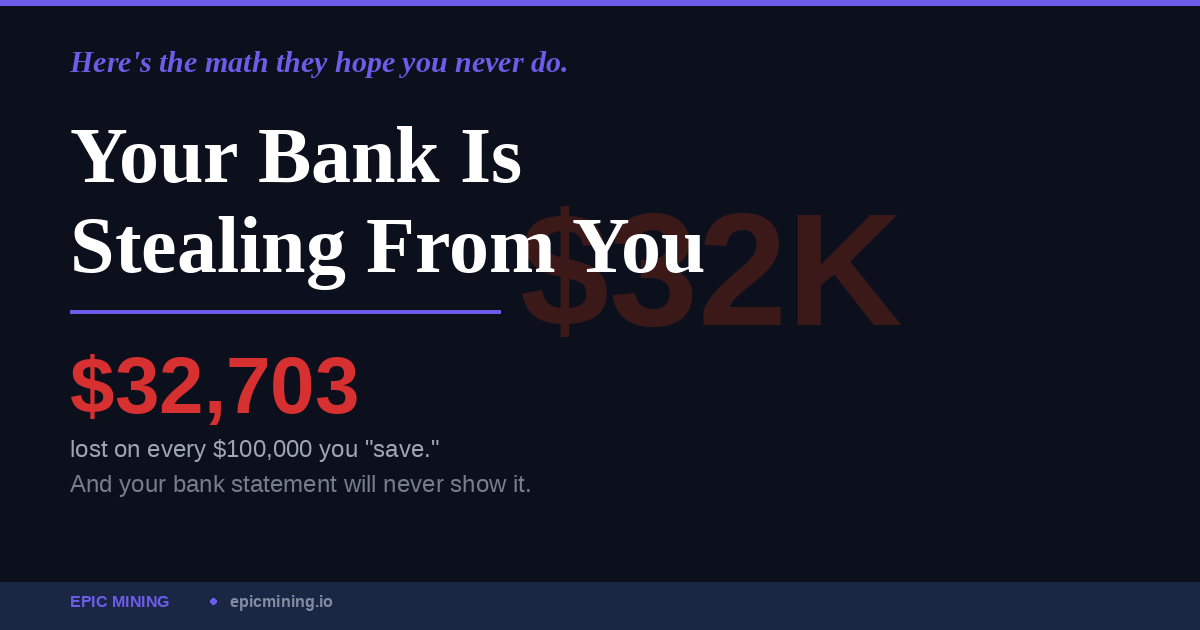
Your bank pays you somewhere between 0.5% and 2% interest. If inflation runs at 2% and your bank pays 1.5%, you lose 0.5% of your purchasing power every single year. That gap might sound small. Over 10 years, it compounds into a loss of $32,703 on every $100,000 you hold in cash.

Nobody shows you this number on your bank statement. The balance goes up by a few dollars each month, so it feels like your money is growing. But what that balance can actually buy is shrinking, quietly, every single day.

The Purchasing Power Erosion Table

Year $100,000 in Savings (1.5% APY) What $100K Buys (2% Inflation) Real Loss
2016 $100,000 $100,000 $0
2018 $103,022 $104,060 ($1,038)
2020 $106,136 $108,243 ($2,107)
2022 $109,344 $112,551 ($3,207)
2024 $112,649 $116,986 ($4,337)
2026 $116,054 $121,899 ($5,845)

Why Your Bank Statement Lies to You

Your bank statement shows your nominal balance. It never shows your real balance, which is what your money can actually purchase. If you deposited $100,000 ten years ago and your bank paid 1.5% interest, your statement shows roughly $116,054 today. That looks like a win.

But $100,000 worth of goods in 2016 now costs approximately $121,899. Your real purchasing power did not grow. It shrank by nearly $6,000. The bank made money lending your deposits. You lost money sitting in them.

This is not a bug in the system. It is the system. Central banks target inflation because it makes government debt cheaper to repay over time. The cost of that policy is paid by everyone holding cash.

What If You Had Stored Value in Bitcoin Instead?

Bitcoin has a fixed supply of 21 million coins. No central bank can print more. No government can inflate it away. Over any four year holding period in Bitcoin’s history, it has outperformed cash in a savings account.

Asset 2016 Value 2026 Value Real Return
Savings Account (1.5%) $100,000 $116,054 ($5,845 real loss)
S&P 500 $100,000 $230,000 +$108,101 real
Gold $100,000 $165,000 +$43,101 real
Bitcoin $100,000 $12,800,000+ +$12,678,101 real

The volatility is real. Bitcoin drops 30% to 50% in bear markets. But if your time horizon is four years or longer, the math has always favored Bitcoin over cash.

You Do Not Have to Buy Bitcoin at Market Price

Most people buy Bitcoin on an exchange at whatever the current price is. But there is another way. Bitcoin mining lets you produce Bitcoin below market price by converting electricity into BTC.

At facilities running 6 to 7 cents per kWh, a current generation miner produces Bitcoin at a cost well below what you would pay on Coinbase or Kraken. Instead of buying at retail, you are producing at wholesale.

You do not need to build a facility or manage hardware yourself. Hosted mining gives you access to institutional electricity rates and professional maintenance. You own the machine. You keep the Bitcoin.

$32,703
lost in purchasing power on $100,000 held in a savings account over 10 years

Frequently Asked Questions

How much money do you lose to inflation each year?

At the official target of 2% inflation, $100,000 in savings loses roughly $2,000 in purchasing power per year. Over 10 years, that same $100,000 buys what $82,000 would have bought when you deposited it. Real inflation on everyday costs like groceries, rent, and energy often runs between 5% and 8%, making the actual loss significantly higher.

Does a savings account protect against inflation?

No. Most savings accounts pay between 0.5% and 2% interest. If inflation runs at 2% and your bank pays 1.5%, you lose 0.5% of your purchasing power per year. Your account balance grows, but what that balance can actually buy shrinks. Over 20 years, this gap compounds into a loss of 15% to 20% in real purchasing power.

Why do central banks target 2% inflation?

Central banks target 2% inflation because it makes government debt cheaper to repay over time. When a government borrows money today and pays it back in future dollars that are worth less, the real cost of that debt decreases. Inflation is the mechanism that allows governments to borrow beyond their means and quietly reduce the burden by devaluing the currency you hold.

Is Bitcoin a better store of value than a savings account?

Over any 4+ year period in Bitcoin’s history, holding Bitcoin has outperformed holding cash in a savings account. Bitcoin has a fixed supply of 21 million coins, which means no central bank can print more of it. Bitcoin is volatile in the short term, but the case for it as a store of value gets stronger the longer your time horizon.

Can I mine Bitcoin instead of buying it?

Yes. Bitcoin mining means running specialized hardware that earns Bitcoin by processing transactions on the network. Instead of buying Bitcoin at market price, you produce it at your cost of electricity. In hosted facilities running at 6 to 7 cents per kWh, you can produce Bitcoin at a cost well below market price.

Keep Reading

Last updated: 2026-04-12