icon New mining location added: Finland More information

The Two Year Fork That Changes Everything

Every four years, the amount of new Bitcoin entering circulation gets cut in half. Every time it has happened, what followed changed everything.

The Halving: Bitcoin’s Built In Supply Shock

Every 210,000 blocks, roughly every four years, Bitcoin’s mining reward is cut in half. This is called the halving. It is hardcoded into Bitcoin’s protocol and cannot be changed by anyone. In 2009 miners earned 50 BTC per block. In 2024 that dropped to 3.125 BTC.

This matters because Bitcoin’s price is driven by supply and demand. When the supply of new coins entering the market gets cut by 50%, but demand stays the same or increases, price pressure builds. Every previous halving has preceded a massive bull run within 12 to 18 months.

The 2024 halving has already happened. If history repeats, the most explosive part of this cycle is directly ahead.

The Historical Pattern

Halving Date Price at Halving Cycle Peak Return
1st Nov 2012 $12 $1,100 +9,000%
2nd Jul 2016 $650 $19,700 +2,930%
3rd May 2020 $8,600 $69,000 +702%
4th Apr 2024 $64,000 TBD In progress

The pattern is not guaranteed. Past performance does not guarantee future results. But the supply dynamics are mechanical. Fewer new coins are produced every day while demand from institutions, ETFs, and individuals continues to grow.

The Two Year Window

This is why we call it the two year fork. After each halving, there is roughly a 12 to 24 month window where Bitcoin tends to move aggressively to the upside. After the 2012 halving, Bitcoin ran from $12 to over $1,100. After 2016, from $650 to nearly $20,000. After 2020, from $8,600 to $69,000.

The 2024 halving occurred in April. That puts the projected cycle peak somewhere between late 2025 and mid 2026. This window does not last forever. The time to position is before the move, not after it.

This is also why the timing of purchasing mining hardware matters. Miners bought before or during the early stages of a bull run benefit from both the rising Bitcoin price and the declining cost basis of production.

What This Means for Miners

If you start mining now, you are producing Bitcoin during what has historically been the most profitable phase of the cycle. The reward per block is smaller, but the value of each coin is climbing.

Miners win twice in this phase: the Bitcoin they produce appreciates in value, and the machines they own also increase in resale value as demand for hashrate grows. This dual return is unique to mining and does not exist when you simply buy Bitcoin on an exchange.

The fork in the road is here. You either position before the move, or you watch it happen from the sidelines.

50%
reduction in new Bitcoin supply every four years, creating the most predictable supply shock in financial history

Frequently Asked Questions

What is the Bitcoin halving?

The halving is a programmed event that cuts the Bitcoin mining reward in half every 210,000 blocks, approximately every four years. It reduces the rate of new Bitcoin creation, creating a supply shock that has historically preceded major price increases.

When is the next Bitcoin halving?

The most recent halving occurred in April 2024, reducing the block reward to 3.125 BTC. The next halving is expected around 2028, when the reward will drop to 1.5625 BTC per block.

Does the halving always lead to a price increase?

Historically, every halving has been followed by a significant price increase within 12 to 18 months. However, past patterns do not guarantee future results. The supply dynamics are mechanical, but price also depends on demand, macro conditions, and market sentiment.

How does the halving affect miners?

The halving cuts mining revenue per block in half. Miners with high electricity costs may become unprofitable. Efficient miners with low power costs continue to profit, and if Bitcoin’s price rises as it has after previous halvings, mining becomes very profitable despite the reduced block reward.

Keep Reading

Last updated: 2026-04-12

Start Mining Bitcoin This Week (No Experience Needed)

You have read enough. You know the economics. You understand the cycle. Here is the action checklist. One week from now, you could have Bitcoin hitting your wallet.

The Checklist

This article strips away all the theory and gives you pure action. If you want the deep dive, read How to Start Bitcoin Mining in 7 Days. If you want to move fast, follow this checklist.

Step 1: Contact a hosted mining provider. Tell them you want to buy and host a current generation ASIC miner. Ask about their electricity rate, hosting packages, and available machines.

Step 2: Choose and purchase your machine. A current generation ASIC costs $3,000 to $8,000. Your provider can recommend the best option for your budget.

Step 3: Download a Bitcoin wallet app (BlueWallet for mobile, Sparrow for desktop). Write down your seed phrase on paper. Store it securely.

Step 4: Send your wallet address to your hosting provider. They configure your machine and mining pool.

Step 5: Wait for installation confirmation. Within 24 to 48 hours, Bitcoin starts arriving in your wallet.

That is it. Five steps. One week. You are mining.

Do Not Overthink This

Analysis paralysis kills more mining plans than bad economics. You can spend months comparing machines, evaluating hosting providers, and reading about the halving cycle. Or you can start with one machine this week and learn by doing.

Start small. Buy one machine. See the Bitcoin hit your wallet. Understand the economics firsthand. Then decide if you want to scale. Every large mining operation started with a single machine.

The cycle is moving. Every day you wait is a day your machine could have been producing Bitcoin.

What to Expect in Your First Month

Week 1: Your machine is installed and begins producing. You will see small daily deposits in your wallet. Do not panic about daily fluctuations in Bitcoin price or mining revenue. This is normal.

Week 2 to 3: You will get comfortable with the monitoring dashboard. You will see your total Bitcoin accumulation growing. The daily rhythm becomes familiar.

Week 4: You will have a clear picture of your machine’s monthly output and can calculate your projected ROI timeline. Most people at this point are already thinking about adding a second machine.

Decide early whether you want to hold or sell your mined Bitcoin. Having a strategy from day one beats figuring it out later.

5 Steps
from zero to mining Bitcoin. Stop researching. Start producing.

Frequently Asked Questions

How fast can I start mining Bitcoin?

With hosted mining, you can go from first contact to Bitcoin in your wallet within 5 to 7 days. The process is: choose provider, buy machine, set up wallet, provide wallet address, wait for installation.

What if I have no technical experience?

That is fine. Hosted mining providers handle all technical setup. You need a Bitcoin wallet app and a decision on which machine to buy. Everything else is handled for you.

How much money do I need to start?

Minimum startup is roughly $3,500 (budget machine plus first month hosting). A mid range setup is $5,000 to $6,000. Premium setup with top tier hardware is $8,000 to $8,500.

Should I start with one machine or several?

Start with one. See the economics firsthand. Verify everything works as expected. Then scale. There is no advantage to buying multiple machines before you have validated the process with one.

Keep Reading

Last updated: 2026-04-12
The Bitcoin Halving Explained: Why Supply Cuts Matter

Every 210,000 blocks, the amount of new Bitcoin created gets cut in half. This single mechanism drives the most powerful recurring pattern in financial markets.

What Is the Bitcoin Halving?

The Bitcoin halving is a programmed event built into Bitcoin’s code that reduces the mining reward by 50% approximately every four years. When Bitcoin launched in 2009, miners earned 50 BTC per block. After the first halving in 2012, that dropped to 25. Then 12.5 in 2016. Then 6.25 in 2020. The most recent halving in April 2024 reduced it to 3.125 BTC.

This schedule is not set by a committee. It is enforced by code that every Bitcoin node on the planet runs independently. No government, company, or individual can change it. The halving will continue until the final Bitcoin is mined around the year 2140.

This is what makes Bitcoin fundamentally different from fiat currencies. Dollars can be printed without limit. Bitcoin’s supply follows a fixed, transparent, and unchangeable schedule.

Why the Halving Matters for Price

Supply and demand drive price. The halving cuts new supply by 50% while demand from institutions, ETFs, and individuals continues to grow. When supply shrinks and demand grows, price increases.

Halving Date Reward Before Reward After Price at Halving Cycle Peak
1st Nov 2012 50 BTC 25 BTC $12 $1,100
2nd Jul 2016 25 BTC 12.5 BTC $650 $19,700
3rd May 2020 12.5 BTC 6.25 BTC $8,600 $69,000
4th Apr 2024 6.25 BTC 3.125 BTC $64,000 In progress

Every previous halving has been followed by a major bull run within 12 to 18 months. The magnitude of returns has decreased with each cycle as Bitcoin’s market cap grows, but the direction has been consistent. The two year window after each halving is historically the best time to hold Bitcoin.

How the Halving Affects Miners

The halving is a double edged sword for miners. On one hand, you earn half as much Bitcoin per block. On the other hand, if price rises as it has historically, the reduced Bitcoin is worth more in dollar terms.

Inefficient miners with high electricity costs get pushed out after each halving. This is healthy for the network because it consolidates hashrate among the most efficient operators. If you run efficient hardware at competitive power rates, the halving actually reduces your competition.

Post halving periods have historically been the most profitable for well positioned miners. Less competition, rising prices, and increasing machine values create a triple tailwind.

The 2024 Halving and What Comes Next

The April 2024 halving reduced the block reward from 6.25 to 3.125 BTC. Based on historical patterns, the most explosive price action of this cycle is expected between late 2025 and mid 2026.

The next halving is projected for 2028, when the reward drops to 1.5625 BTC. Each halving makes Bitcoin scarcer and mining more competitive. The time to position, whether buying or mining, is before each halving cycle plays out, not after.

If you are reading this in 2026, you are still in the sweet spot of the cycle. The supply cut has happened. The price response is underway. The window is open.

3.125 BTC
the current block reward after the 2024 halving, down from 50 BTC when Bitcoin launched in 2009

Frequently Asked Questions

What is the Bitcoin halving?

The halving is a programmed event that cuts the Bitcoin mining reward in half every 210,000 blocks, roughly every four years. It reduces the rate at which new Bitcoin enters circulation, creating predictable supply reductions.

When was the last Bitcoin halving?

The most recent halving occurred in April 2024, reducing the block reward from 6.25 to 3.125 BTC per block. The next halving is expected around 2028.

Does the halving make Bitcoin more valuable?

Historically, yes. Every halving has been followed by a significant price increase within 12 to 18 months. The mechanism is simple: less new supply with equal or growing demand pushes prices higher. However, past performance does not guarantee future results.

Will Bitcoin mining end after all halvings?

The final Bitcoin will be mined around the year 2140. After that, miners will earn revenue solely from transaction fees rather than block rewards. The network is designed to remain functional and secure through fee incentives long after block rewards diminish.

Keep Reading

Last updated: 2026-04-12

What to Do With Your Mined Bitcoin (Complete Guide)

Mining produces Bitcoin. But what you do with that Bitcoin determines whether mining was a good investment or a great one. Here is the complete playbook.

The Four Options

You mine Bitcoin every day. Each day you face the same decision: what do you do with it? You have four main options, and the right choice depends on your financial situation, time horizon, and conviction level.

Option 1: Hold (HODL). Keep all mined Bitcoin in cold storage and sell nothing. This maximizes upside in a rising market.

Option 2: Sell immediately. Convert all mined Bitcoin to fiat as it is produced. This locks in profit and eliminates price risk.

Option 3: Hybrid. Sell enough to cover operating costs. Hold the rest. This is what most experienced miners do.

Option 4: Borrow against it. Use your Bitcoin as collateral for a loan. Access liquidity without selling and triggering taxes.

The HODL Strategy

HODLing (holding for the long term) is the simplest and historically the most profitable strategy. Over any four year cycle, Bitcoin has reached new all time highs. Miners who accumulate through bear and bull markets build substantial positions.

The downside of HODLing is that you need other income to cover your mining costs. If electricity and hosting cost $150 per month, that comes from somewhere. If you can afford that from other income, HODLing lets your Bitcoin position compound without interruption.

Secure your holdings properly. Hardware wallets for smaller amounts. Multisig for larger positions. Never leave significant Bitcoin on an exchange.

The Sell Strategy

Selling immediately converts your mining operation into a cash flow business. You know your input costs (hardware and electricity) and you know your output (Bitcoin converted to fiat). The margin is your profit.

This approach makes sense if you are mining to generate income, if you need the cash flow, or if you want to reinvest profits into additional machines. It removes the volatility risk of holding Bitcoin.

The downside is you miss the upside. If Bitcoin doubles after you sell, you captured none of that appreciation.

The Hybrid Strategy (Recommended)

The hybrid approach is what most experienced miners use. Sell enough Bitcoin each month to cover your electricity and hosting costs. Hold everything else. This keeps your mining operation self funding while you accumulate Bitcoin.

Example: Your miner produces $450 in Bitcoin per month. Your hosting costs are $130. You sell $130 worth and hold $320. After 12 months, you have covered all costs and accumulated roughly $3,840 in Bitcoin with zero out of pocket expense after the initial machine purchase.

This is the strategy we recommend for most miners. It combines the cash flow certainty of selling with the upside of accumulation.

The Borrow Strategy

Borrowing against your Bitcoin lets you access liquidity without selling. You use BTC as collateral for a fiat loan. You spend the loan proceeds. Your Bitcoin stays yours and continues to appreciate.

This is the strategy ultra wealthy Bitcoin holders use. They never sell. They borrow. Selling triggers capital gains tax. Borrowing does not (in most jurisdictions). You preserve your Bitcoin position and your tax advantage.

This strategy works best for larger holdings. Bitcoin backed mortgages are an emerging option for miners who have accumulated significant BTC.

$320/month
in Bitcoin accumulated using the hybrid strategy, after covering all mining costs from production

Frequently Asked Questions

Should I sell my mined Bitcoin or hold it?

Most experienced miners use a hybrid approach: sell enough to cover operating costs and hold the rest. This keeps mining self funding while building a long term Bitcoin position.

How do I keep my mined Bitcoin safe?

Use a hardware wallet for amounts under $50,000. For larger holdings, consider a multisig setup requiring multiple keys. Never leave significant Bitcoin on an exchange. Write seed phrases on paper or metal and store them securely offline.

Can I borrow against my Bitcoin instead of selling?

Yes. Several platforms offer Bitcoin backed loans. You use BTC as collateral and receive a fiat loan. You keep your Bitcoin and avoid capital gains tax. This strategy works best for larger holdings.

What is the best strategy for new miners?

Start with the hybrid approach. Sell enough Bitcoin to cover your monthly hosting and electricity. Hold the rest. This eliminates out of pocket costs after your initial machine purchase while letting you accumulate BTC.

Keep Reading

Last updated: 2026-04-12

Bitcoin Mining Strategy: When, How, and Why to Start

Mining without a strategy is gambling. Mining with a strategy is a business. Here are the frameworks that separate the two.

Mining Is a Business, Not a Bet

The difference between a miner who profits and one who does not is rarely luck. It is strategy. The profitable miner understands their electricity cost, the Bitcoin price cycle, hardware depreciation, and cash flow timing. The unprofitable miner bought a machine because someone on YouTube said it was a good idea.

Bitcoin mining is a business with predictable inputs (hardware cost, electricity rate) and variable outputs (Bitcoin price, network difficulty). Like any business, the key is managing the inputs you control to maximize returns on the variables you cannot.

This article gives you the strategic framework to make informed decisions about when to start, what equipment to buy, how long to run it, and when to upgrade.

Timing Your Entry

The Bitcoin cycle follows a roughly four year pattern driven by the halving. Understanding where you are in the cycle changes everything about your strategy.

Early in the cycle (just after halving): Equipment prices are reasonable. Bitcoin price has not yet surged. This is the optimal entry point. Miners who start here benefit from the full upside of the cycle.

Mid cycle (12 to 24 months after halving): Bitcoin price is rising. Equipment prices increase as demand grows. Entry is still profitable but at higher cost. Machine prices peak during the euphoric phase of the cycle.

Late cycle (bear market): Bitcoin price has corrected. Equipment is cheapest. This is counterintuitively a great time to buy machines and prepare for the next cycle. Miners who buy at the bottom of the bear market get the best deal on hardware.

Choosing Your Equipment

Not all miners are created equal. The key metric is joules per terahash (J/TH), which measures how much electricity the machine uses to produce a unit of hashrate. Lower is better. Current generation machines run at 15 to 20 J/TH. Older models at 30+ J/TH are not worth running at most electricity rates.

Buy the most efficient hardware your budget allows. A cheaper, less efficient machine costs more in electricity over its lifetime. The machine you buy today needs to be profitable for 3 to 5 years. Efficiency determines whether it lasts that long economically.

Buy from authorized dealers or directly from manufacturers. The used market has deals but also risks. If you are new, start with new equipment through a hosted mining provider who handles procurement.

Cash Flow and Accumulation Strategy

You have two primary strategies for managing your mining output. Strategy 1: Sell immediately. Convert all mined Bitcoin to fiat as it is produced. This locks in profit and reduces price exposure. Best for miners who need cash flow or who are risk averse.

Strategy 2: HODL. Accumulate all mined Bitcoin and sell nothing. This maximizes upside in a rising market but exposes you to price downside. Best for miners with other income sources who are building a long term Bitcoin position.

Strategy 3: Hybrid. Sell enough Bitcoin to cover your operating costs (electricity and hosting). Hold the rest. This approach ensures your mining is self funding while still accumulating BTC. Most experienced miners use some version of this hybrid approach.

When to Exit or Upgrade

Mining equipment is a depreciating asset. At some point, your machine produces less Bitcoin per kWh than a newer model. That is the signal to sell the old machine and upgrade. Do not hold machines past their economic useful life.

Monitor your daily revenue per kWh consumed. When it drops below a threshold where you are barely covering electricity, it is time to upgrade. In a bull market, you can often sell your old machine for near what you paid for it, making the upgrade nearly free.

The dual return of mining, Bitcoin production plus machine appreciation, is strongest when you actively manage your fleet rather than setting and forgetting.

3 to 5 years
the economic lifespan of a well chosen mining strategy, from hardware purchase through accumulation and exit

Frequently Asked Questions

When is the best time to start Bitcoin mining?

The best time is early in the halving cycle, shortly after or in the months following a halving. Equipment prices are reasonable and the full price appreciation of the cycle is ahead. The second best time is at the bottom of a bear market when hardware is cheapest.

Should I sell my mined Bitcoin or hold it?

Most experienced miners use a hybrid strategy: sell enough to cover operating costs and hold the rest. This keeps mining self funding while building a long term Bitcoin position. The right balance depends on your cash flow needs and conviction in Bitcoin’s price trajectory.

How do I choose the right mining equipment?

Focus on efficiency, measured in joules per terahash (J/TH). Lower is better. Current generation machines at 15 to 20 J/TH are recommended. Buy from authorized dealers and choose the most efficient model your budget allows.

When should I upgrade my mining equipment?

When your daily revenue per kWh drops below your target margin, it is time to upgrade. In bull markets, old machines often sell for near purchase price, making upgrades nearly free. Do not hold equipment past its economic useful life.

Keep Reading

Last updated: 2026-04-12
Buying vs Producing Bitcoin: Which Strategy Wins?

There are two ways to get Bitcoin. One costs you market price. The other gives you a 30% to 50% discount. Here is the comparison most people never see.

Two Ways to Acquire Bitcoin

The default way to get Bitcoin is to open an exchange account and buy it at whatever the market price is. If Bitcoin is at $80,000, you pay $80,000 per coin plus fees. Simple, instant, and the way 99% of people do it.

The other way is to produce it. Bitcoin mining uses specialized hardware to earn Bitcoin by processing transactions. Your cost to produce one Bitcoin is determined by your electricity rate, machine efficiency, and network difficulty. At competitive power rates, that cost is well below market price.

Buying gives you Bitcoin immediately. Producing gives you Bitcoin at a discount, continuously, for as long as the machine runs. Both have trade offs. The right answer depends on your goals, timeline, and capital.

The Cost to Produce One Bitcoin

Electricity Rate Monthly Cost Monthly BTC Output Cost Per Bitcoin vs Market ($80K)
$0.065/kWh $172 0.0057 BTC $30,175 62% cheaper
$0.065/kWh $215 0.0057 BTC $37,719 53% cheaper
$0.07/kWh $302 0.0057 BTC $52,807 34% cheaper
$0.10/kWh $431 0.0057 BTC $75,439 6% cheaper
$0.12/kWh $517 0.0057 BTC $90,526 13% more expensive

The numbers above show the all in cost to produce one Bitcoin at different electricity rates using a current generation miner. At 6 to 7 cents per kWh, which is what hosted mining facilities typically offer, you produce Bitcoin at roughly $30,000 to $40,000 per coin.

If Bitcoin trades at $80,000, that is a 50% to 62% cost advantage over buying on an exchange. This is why the largest Bitcoin holders in the world are miners, not buyers.

Buying: Pros and Cons

Buying Bitcoin is simple. You set up an account, deposit funds, and purchase. You have the Bitcoin in minutes. The downside is you pay full market price, plus exchange fees of 0.5% to 1.5%. You get a one time allocation of Bitcoin with no ongoing production.

Buying makes sense when you want immediate exposure, when you have a lump sum to deploy, or when you believe the price is about to move quickly and you want to catch the move.

The weakness of buying is that it is a single transaction. Once you buy, your Bitcoin position only grows if you buy more. There is no compounding. No ongoing production. No cost advantage.

Producing: Pros and Cons

Producing Bitcoin through mining gives you a continuous stream of BTC at below market cost. Your machine works 24/7, earning Bitcoin every day. The longer it runs, the more you accumulate. At competitive electricity rates, your cost basis is dramatically lower than market price.

The trade off is time. Mining does not give you all your Bitcoin on day one. It takes months to reach ROI and years to maximize the machine’s productive life. You also have ongoing electricity costs.

Miners win twice because the Bitcoin they produce appreciates in value over time, and the machines themselves can appreciate during bull markets when demand for hashrate increases.

The Verdict

For most people, the optimal strategy is both. Buy some Bitcoin for immediate exposure. Start mining for ongoing production at a discount. The combination gives you instant allocation plus a cost effective way to keep stacking.

If you have to choose one, mining wins over any holding period longer than 12 to 18 months, assuming competitive electricity rates. The math is clear: producing an asset below market price is a better deal than buying it at retail.

30% to 50%
discount when producing Bitcoin through mining vs buying on an exchange

Frequently Asked Questions

Is it cheaper to mine Bitcoin or buy it?

At electricity rates of 4 to 7 cents per kWh, mining produces Bitcoin at 30% to 60% below market price. At rates above 10 cents, mining becomes less cost effective and buying may be the better option. Hosted mining facilities typically offer rates in the 4 to 5 cent range.

How long does it take to get your money back from mining?

At competitive electricity rates with Bitcoin at current prices, most miners reach ROI within 8 to 14 months. The machine then continues producing Bitcoin for 3 to 5 years, generating returns well beyond the initial investment.

Can I do both buying and mining?

Yes, and this is the strategy most experienced Bitcoin investors use. Buying gives you immediate exposure. Mining gives you ongoing production at a discount. The combination maximizes both your short term position and long term accumulation.

What electricity rate do I need for mining to be profitable?

Mining is profitable at electricity rates below approximately 8 cents per kWh with current generation hardware. At 4 to 5 cents, which hosted facilities offer, profitability is strong. Above 10 cents, buying Bitcoin directly becomes more cost effective.

Keep Reading

Last updated: 2026-04-12
Every Bitcoin Mining Doubt, Answered

You have concerns. That is healthy. Here is every common objection to Bitcoin mining, answered with data, logic, and real world experience. No hype. Just facts.

Is It Too Late to Start Mining?

People have asked this at every point in Bitcoin’s history. In 2012. In 2016. In 2020. Each time, it was not too late. The economics evolve, but mining remains profitable for well positioned operators.

The halving reduces supply every four years, historically driving price increases that more than compensate for the reduced block reward. At current Bitcoin prices and competitive electricity rates, mining is highly profitable in 2026.

The question is not whether it is too late. It is whether you are positioned correctly: efficient hardware, cheap electricity, and a clear strategy.

Is Bitcoin Mining a Scam?

Bitcoin mining itself is not a scam. It is the process by which new Bitcoin is created and transactions are verified. It is the foundational mechanism of the Bitcoin network. There are, however, scams within the mining industry.

Cloud mining contracts, hashrate rental schemes, and fake hosting providers exist. The way to avoid them: always own the physical machine. Always verify the facility exists. Never invest in anything where you cannot verify the hardware.

Legitimate hosted mining means you own a real machine in a real facility. You can visit it, verify it, and withdraw it at any time.

Will Governments Ban Mining?

Some countries have restricted or banned mining, most notably China in 2021. The result? The hashrate that left China migrated to the US, Kazakhstan, Canada, and other jurisdictions. Total network hashrate recovered within months and has since set new all time highs.

In the US, Bitcoin mining is legal and increasingly encouraged. Texas actively recruits miners as grid stabilizers. Multiple states have passed legislation protecting the right to mine. The US now hosts the largest share of global hashrate.

Environmental concerns are the most likely avenue for regulation, but the industry’s shift toward renewable and nuclear energy is addressing this proactively.

What If Bitcoin’s Price Crashes?

Bitcoin has dropped 50% to 80% from peak to trough in every cycle. This is normal. Miners with cheap electricity remain profitable even during significant price drops because their production cost is well below even bear market prices.

At $0.065/kWh, the cost to produce one Bitcoin is roughly $37,000. Even if Bitcoin drops to $40,000, you are still producing above cost. At $30,000, you are near breakeven. Below that, you can pause mining and wait.

The strategic approach is to mine consistently and accumulate. Historically, every bear market has been followed by new all time highs.

Is Mining Bad for the Environment?

Over 56% of Bitcoin mining uses sustainable energy. Mining monetizes waste energy, captures methane, and stabilizes electrical grids. The environmental argument against mining is increasingly outdated as the industry transitions to clean power.

Nuclear powered mining produces zero carbon emissions. Flare gas mining eliminates methane. Renewable energy integration is a growing trend. Mining is becoming one of the cleanest industrial activities per unit of value created.

Every Objection
answered with data, not opinions. Mining is real, legal, profitable, and getting cleaner every year.

Frequently Asked Questions

Is it too late to start Bitcoin mining?

No. Mining has been profitable in every year of Bitcoin’s existence for operators with efficient hardware and competitive electricity rates. The halving cycle continues to drive price appreciation that compensates for reduced block rewards.

Is Bitcoin mining a scam?

Bitcoin mining itself is legitimate and fundamental to the Bitcoin network. Some companies offering cloud mining or hashrate contracts are scams. Always own the physical machine and verify the hosting facility exists.

Can governments ban Bitcoin mining?

Some countries have restricted mining, but hashrate simply migrates to friendlier jurisdictions. The US is now the world’s largest mining hub with multiple states actively protecting mining rights. A global ban is practically impossible.

What happens if Bitcoin’s price drops 50%?

Miners with cheap electricity remain profitable even during significant price drops. At $0.065/kWh, production cost is around $37,000. As long as Bitcoin trades above production cost, mining remains profitable. In extreme bear markets, you can pause and wait.

Is Bitcoin mining bad for the environment?

Over 56% of mining uses sustainable energy. Mining captures waste methane, monetizes excess renewables, and stabilizes power grids. The industry is rapidly transitioning to nuclear and renewable energy sources.

How risky is Bitcoin mining as an investment?

The main risks are Bitcoin price decline and rising network difficulty. These are mitigated by running efficient hardware at cheap electricity rates, which keeps your breakeven price low. Mining is less risky than buying Bitcoin directly because your cost basis is lower.

Keep Reading

Last updated: 2026-04-12
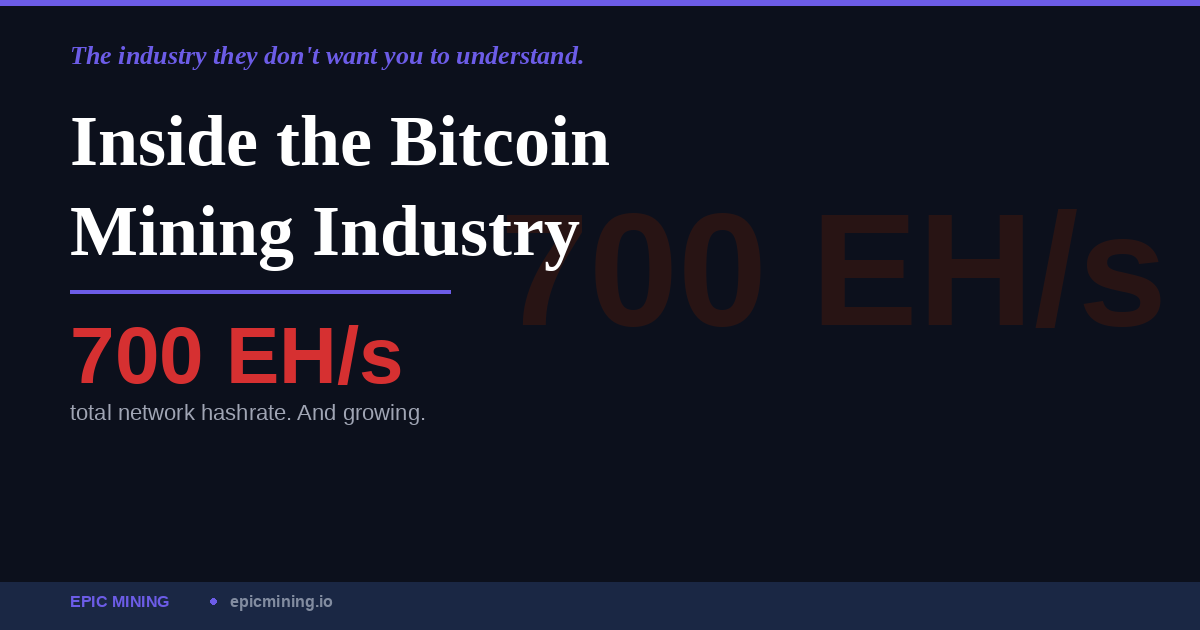
Inside the Bitcoin Mining Industry: A Complete Guide

From a few laptops in 2009 to a global industry consuming more power than some countries. Here is the complete map of Bitcoin mining in 2026.

How Big Is the Bitcoin Mining Industry?

The Bitcoin mining industry now operates at over 700 exahashes per second of total computing power. That is a number so large it defies comparison to any other computing system on earth. The industry consumes an estimated 150 terawatt hours of electricity annually, roughly equivalent to the energy consumption of Poland.

In dollar terms, miners collectively earn over $30 million per day in block rewards and transaction fees. The publicly traded mining companies alone have a combined market capitalization in the tens of billions. But they represent only a fraction of total network hashrate. The majority of mining is done by private operators ranging from individuals to large private companies.

This is not a niche hobby. It is a global industry with sophisticated participants, massive capital deployment, and significant economic output.

The Players: Who Mines Bitcoin?

The mining industry has four main categories of participants. First, the public companies: Marathon Digital, Riot Platforms, CleanSpark, and others. They operate massive facilities, issue stock, and report quarterly. They make headlines but represent roughly 20% to 25% of total hashrate.

Second, large private operators. These are companies that run tens of thousands of machines but do not trade on public markets. They often have superior economics because they do not have the overhead costs of being publicly listed.

Third, sovereign and institutional miners. Nations like Bhutan, El Salvador, and various Middle Eastern states are mining Bitcoin using state resources. Institutional investors are deploying capital into mining as an alternative to buying Bitcoin on exchanges.

Fourth, individual miners. People who own one to a hundred machines, often through hosted mining arrangements. This category is growing faster than any other as infrastructure makes it easier for individuals to participate.

How Mining Facilities Work

A professional mining facility is essentially a warehouse full of computers with three critical infrastructure requirements: cheap electricity, effective cooling, and reliable internet.

The facilities range from converted warehouses to purpose built structures. The best operations secure power purchase agreements at 3 to 6.5 cents per kWh, use industrial cooling to keep machines running at optimal temperatures, and maintain 95%+ uptime through professional monitoring and maintenance.

Location is everything. Mining facilities cluster around cheap power sources: hydroelectric dams in the Pacific Northwest, natural gas flares in Texas, wind farms in the Midwest, and increasingly, nuclear power plants. The electricity cost determines whether a facility is profitable or not.

Where Do You Fit In?

You do not need to build a facility or manage thousands of machines to participate in this industry. Hosted mining gives you a single machine inside a professional facility. You get the same electricity rate, the same cooling, the same uptime, just at a scale that works for you.

Think of it like owning a rental property inside a professionally managed building. You own the asset. Someone else handles the operations. You collect the returns. Here is how to get started.

The mining industry is large, competitive, and growing. But the infrastructure now exists for individuals to participate on the same economic terms as the largest operators. That is the opportunity.

700+ EH/s
total Bitcoin network hashrate, with over $30 million earned by miners every day

Frequently Asked Questions

How big is the Bitcoin mining industry?

The industry operates at over 700 exahashes per second and consumes approximately 150 terawatt hours annually. Miners earn over $30 million per day in block rewards and fees. The publicly traded mining companies alone have tens of billions in market cap.

Who are the biggest Bitcoin miners?

The largest public miners include Marathon Digital, Riot Platforms, and CleanSpark. However, public companies represent only 20% to 25% of total hashrate. The majority is controlled by private operators, sovereign miners, and individuals.

Can individuals compete with large mining companies?

Yes, through hosted mining. Individual miners get the same electricity rates, cooling, and uptime as large operators. The cost to produce one Bitcoin is determined by efficiency, not scale. A single machine in a well run facility produces Bitcoin at the same unit cost as ten thousand machines.

Where are Bitcoin mining facilities located?

Mining facilities cluster around cheap electricity. Major locations include Texas (natural gas and wind), the Pacific Northwest (hydroelectric), Scandinavia (geothermal and hydro), the Middle East (cheap natural gas), and increasingly near nuclear power plants.

Keep Reading

Last updated: 2026-04-12
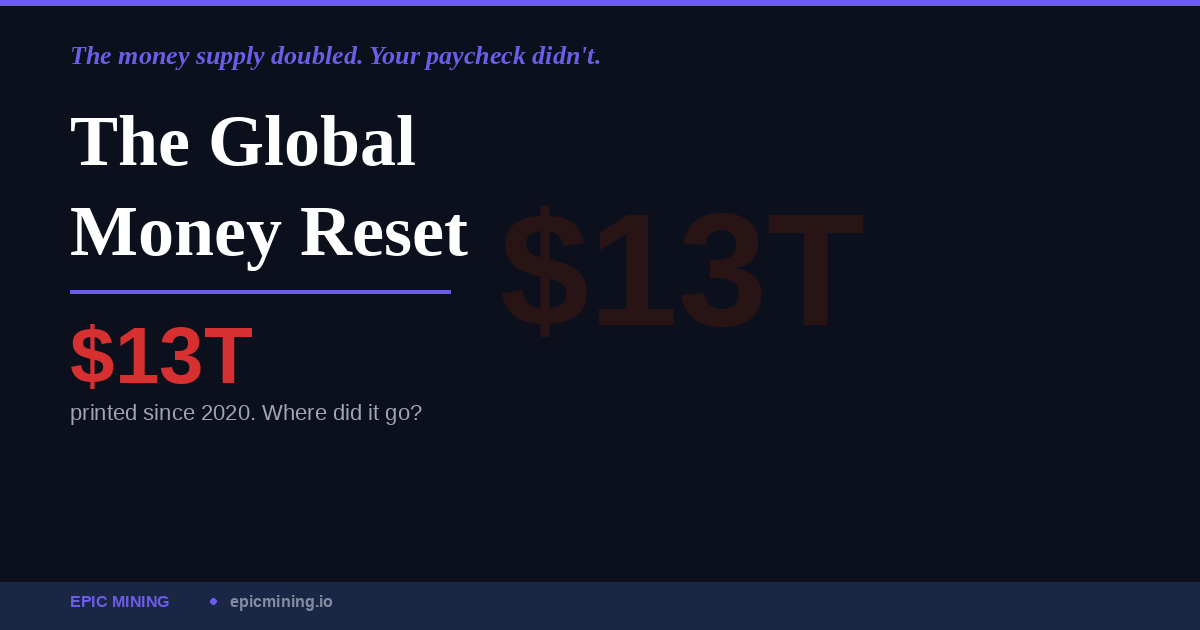
The Global Money Reset Nobody Is Talking About

$13 trillion was created out of thin air since 2020. Central banks are hoarding gold. Something fundamental is shifting, and most people are not paying attention.

$13 Trillion Out of Thin Air

Between 2020 and 2023, the world’s major central banks created more money than in the previous century combined. The Federal Reserve alone expanded its balance sheet from $4 trillion to nearly $9 trillion. The European Central Bank, the Bank of Japan, and the Bank of England all followed the same playbook.

That money did not come from taxes or savings. It was created digitally and injected into the financial system. The stated reason was COVID relief. The real effect was a permanent expansion of the money supply that diluted every dollar, euro, yen, and pound already in circulation.

If the amount of money in the system doubles but the amount of goods and services stays roughly the same, prices rise. Not because things became more valuable, but because each unit of currency became worth less.

Central Banks Are Buying Gold at Record Pace

While telling citizens that inflation is under control, central banks around the world are buying gold at the fastest pace in decades. China, India, Turkey, Poland, and Singapore have all been accumulating gold reserves aggressively since 2022.

Central banks bought over 1,000 tonnes of gold in both 2022 and 2023. They are not doing this because they think the current monetary system is stable. They are hedging against the system they run.

When the people who control the money supply are buying hard assets, that tells you everything you need to know about where they think the value of paper currency is heading. Bitcoin is an even harder asset than gold, with a supply that is mathematically fixed.

The BRICS Currency Push

Brazil, Russia, India, China, and South Africa are actively building financial infrastructure to reduce dependence on the US dollar. De-dollarization is no longer a theory. It is a policy objective for nations representing over 40% of the world’s population.

Saudi Arabia has begun accepting yuan for oil. Russia and China settle bilateral trade in local currencies. New payment systems are being built to bypass SWIFT entirely.

None of this means the dollar disappears tomorrow. But it means the monopoly position that has allowed the US to print unlimited dollars without immediate consequence is eroding. When that privilege weakens further, the inflation you have already seen could accelerate.

What This Means for You

If you hold most of your wealth in a single fiat currency, you are making a concentrated bet that your government will manage its money supply responsibly. History suggests that is a losing bet over any multi-decade period.

The solution is not to panic. It is to diversify into assets that cannot be printed, inflated, or debased by any central authority. Gold has served this role for centuries. Bitcoin is the digital evolution of the same idea, with a supply cap that is enforced by mathematics rather than politics.

You do not have to choose between them. But doing nothing, keeping 100% of your wealth in cash and government bonds, is the riskiest position of all. Learning how to produce Bitcoin through mining is one way to start building a position without buying at market price.

$13 Trillion
printed by central banks since 2020, diluting every dollar in your account

Frequently Asked Questions

How much money was printed during COVID?

The world’s major central banks created over $13 trillion between 2020 and 2023. The US Federal Reserve expanded its balance sheet from $4 trillion to nearly $9 trillion. This was the largest monetary expansion in modern history.

Why are central banks buying gold?

Central banks purchased over 1,000 tonnes of gold in both 2022 and 2023. They are hedging against the currency systems they operate. When the people who control the money supply buy hard assets, it signals concern about the long term value of paper currency.

What is de-dollarization?

De-dollarization is the movement by countries to reduce dependence on the US dollar for international trade. BRICS nations representing over 40% of the world’s population are building alternative payment systems and settling trade in local currencies instead of dollars.

How do I protect my wealth from currency devaluation?

Diversify into assets with fixed or limited supply. Gold and Bitcoin are the two primary hard money assets. Bitcoin has a mathematically fixed supply of 21 million coins. You can also produce Bitcoin through mining, acquiring it below market price instead of buying on an exchange.

Keep Reading

Last updated: 2026-04-12
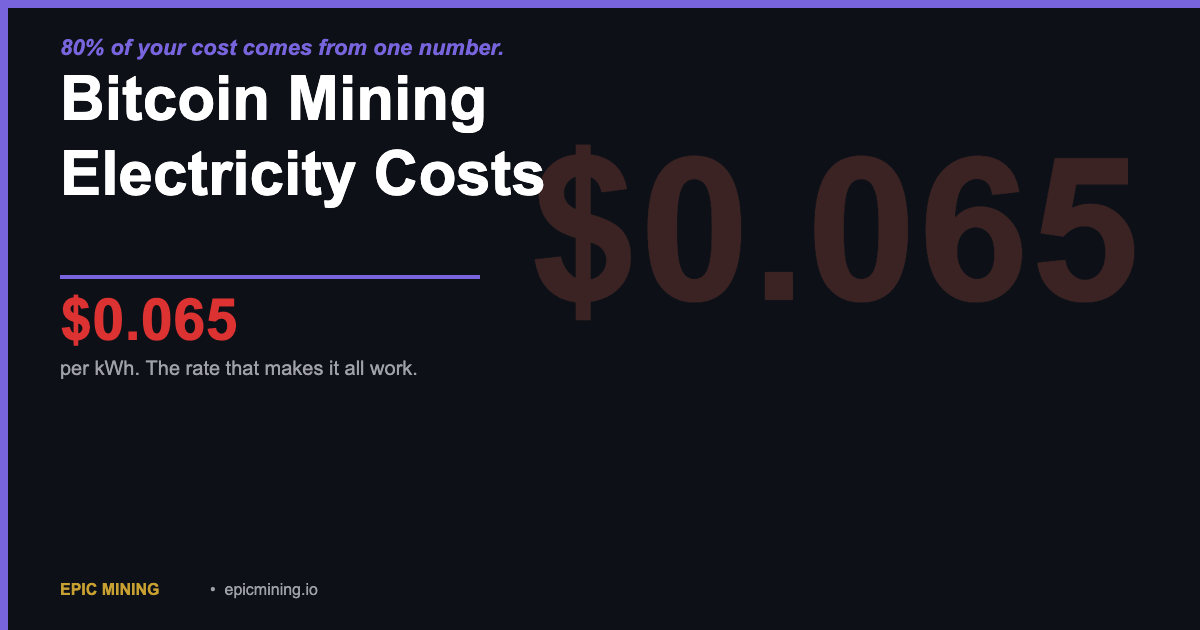
Bitcoin Mining Electricity Costs: The Complete Breakdown

Electricity determines whether you profit or lose. It is the single variable that matters more than any other in Bitcoin mining. Here is the complete breakdown.

Electricity Is 80% of Your Cost

In Bitcoin mining, your two major costs are hardware and electricity. The hardware is a one time purchase. Electricity is ongoing, every hour, every day, for the life of the machine. Over a miner’s 3 to 5 year lifespan, electricity accounts for roughly 80% of total operating cost.

This is why the difference between $0.065/kWh and $0.10/kWh is not incremental. It is the difference between strong profitability and breakeven. Every cent matters.

Understanding your electricity cost is the foundation of any mining decision. Before you buy a machine, before you choose a hosting provider, before you do anything else, you need to know the power rate.

The Rate Table

Electricity Rate Monthly Cost (3,500W) Monthly Profit Annual Profit Verdict
$0.065/kWh $76.65 $379 $4,548 Excellent
$0.065/kWh $102.20 $354 $4,248 Excellent
$0.065/kWh $127.75 $328 $3,939 Strong
$0.07/kWh $178.85 $277 $3,327 Good
$0.10/kWh $255.50 $201 $2,406 Marginal
$0.12/kWh $306.60 $149 $1,793 Thin
$0.15/kWh $383.25 $73 $873 Not recommended

The sweet spot for profitable mining is 4 to 7 cents per kWh. Below 7 cents (common with stranded gas and hydro) is exceptional. Above 8 cents, margins thin quickly. Above 12 cents (typical residential), mining becomes unprofitable with most hardware.

Where Cheap Electricity Comes From

The cheapest electricity for mining comes from stranded or curtailed energy sources. These include natural gas flares at oil wells (wasted gas that would otherwise be burned off), hydroelectric dams with excess capacity, wind and solar farms during periods of overproduction, and nuclear power plants during off peak hours.

Texas has become the largest mining state in the US because of its deregulated power market, abundant natural gas and wind, and energy infrastructure that supports large industrial loads. Mining facilities negotiate power purchase agreements directly with generators at rates far below what residential customers pay.

Hosted mining facilities pass these institutional rates to individual miners. A person hosting one machine gets the same per kWh rate as a company hosting 10,000. This is the key advantage of hosted mining over home mining.

How to Calculate Your Mining Economics

The formula is simple. Monthly revenue (in BTC, converted to USD) minus monthly electricity cost equals monthly profit. Monthly electricity cost equals machine wattage times hours in month times electricity rate.

For a 3,500W miner at $0.065/kWh: 3,500W x 730 hours x $0.065 = $127.75 per month in electricity. If that machine produces $456 in Bitcoin, your monthly profit is $328.25. Your annual profit is $3,939.

Change the rate to $0.10/kWh and the electricity cost jumps to $255.50. Profit drops to $200.50 per month. Change it to $0.12 and you are barely profitable. The rate is everything.

$0.065/kWh
the electricity rate that turns mining into a money machine. Most hosted facilities deliver this or better.

Frequently Asked Questions

How much electricity does Bitcoin mining use?

A single modern ASIC miner consumes approximately 3,500 watts continuously. That is roughly $100 to $130 per month at institutional rates of 6 to 7 cents per kWh, or $250 to $380 at residential rates of 10 to 15 cents.

What is a good electricity rate for mining?

The sweet spot is 4 to 7 cents per kWh. Below 7 cents is exceptional. Above 8 cents, margins compress significantly. Most hosted mining facilities offer rates in the 4 to 5 cent range by purchasing power at institutional scale.

Why is electricity so expensive at home?

Residential electricity includes distribution charges, transmission fees, taxes, and utility company margins on top of the generation cost. Industrial mining facilities buy directly from generators, bypassing most of these additional costs.

Can I use solar power to mine Bitcoin?

Solar can offset mining electricity costs but requires significant upfront investment in panels and batteries for 24/7 operation. The economics work best in sunny regions with high residential electricity rates. For most people, hosted mining at institutional rates is more cost effective.

Keep Reading

Last updated: 2026-04-12