icon New mining location added: Finland More information

What Happens When All 21 Million Bitcoin Are Mined?

The last Bitcoin will be mined around the year 2140. After that, no new Bitcoin will ever be created. But mining will not stop. The network will still need miners to verify transactions, and miners will still earn revenue. Here is how the system is designed to work forever.

When Will the Last Bitcoin Be Mined?

The last Bitcoin is projected to be mined around 2140, approximately 114 years from now. This timeline is set by Bitcoin’s halving schedule: the block reward is cut in half every 210,000 blocks (roughly every four years). As the reward approaches zero through repeated halvings, the amount of new Bitcoin created per block becomes vanishingly small.

Halving Approximate Year Block Reward Total BTC in Circulation
0 (Genesis) 2009 50 BTC 0
1st 2012 25 BTC ~10.5 million
2nd 2016 12.5 BTC ~15.75 million
3rd 2020 6.25 BTC ~18.375 million
4th 2024 3.125 BTC ~19.6 million
5th ~2028 1.5625 BTC ~20.2 million
6th ~2032 0.78125 BTC ~20.5 million
~33rd ~2140 ~0.00000001 BTC (1 satoshi) 21 million

By 2032, over 99% of all Bitcoin will have been mined. By 2040, over 99.8%. The remaining fraction will trickle out over the following century in ever-smaller amounts. The 21 million cap is not a cliff but a very gradual plateau.

~2140
Projected year when the last Bitcoin will be mined, completing the 21 million supply cap

Will Miners Still Earn Money After All Bitcoin Are Mined?

Yes. When the block reward reaches zero, miners will be compensated entirely through transaction fees. Every Bitcoin transaction includes a fee paid by the sender to incentivize miners to include it in a block. These fees already exist today and sometimes represent a significant portion of mining revenue.

During periods of high network activity (like during the 2024 Runes launch or major market moves), transaction fees have temporarily exceeded the block reward. This demonstrates that the fee market can sustain mining even without new Bitcoin being created. As Bitcoin’s user base grows and the network handles more transactions, total fee revenue is expected to increase.

Already happening: The transition from block rewards to transaction fees is not a future event. It is happening right now, gradually. Each halving shifts the revenue mix further toward fees. By 2028, the block reward will be just 1.5625 BTC. By 2032, it will be 0.78125 BTC. Fees will need to grow to fill the gap, and so far, they have tracked in that direction.

What Happens to Bitcoin’s Price When Supply Stops Growing?

When no new Bitcoin is being created, the only way to acquire Bitcoin will be to buy it from someone who already owns it. With fixed supply and growing demand (from population growth, institutional adoption, and increasing recognition as a store of value), basic economics suggests upward price pressure.

This is analogous to gold if all gold mines were simultaneously exhausted. The existing supply would need to serve all global demand. Prices would reflect the scarcity. Bitcoin’s programmed scarcity is even more absolute than gold’s, because gold mining continues to add roughly 1.5% to the above-ground supply each year. Bitcoin’s supply growth is already below 1% annually and declining to zero. Read more about why scarcity drives value in what gives Bitcoin its value.

Will Bitcoin’s Security Survive Without Block Rewards?

This is the most debated question in Bitcoin’s long-term future. Network security depends on miners investing in hash rate, which requires revenue. If transaction fees are insufficient to incentivize enough mining, hash rate could decline, and security could weaken.

Several factors suggest the fee market will be adequate. First, as Bitcoin’s value increases, even small percentage-based fees translate to large dollar amounts. A 0.1% fee on a $1 million transaction is $1,000. Second, Bitcoin’s block space is limited, creating natural competition for inclusion. Third, innovations like the Lightning Network handle small transactions off-chain, reserving the main blockchain for high-value settlements that justify higher fees.

The difficulty adjustment provides an additional safety mechanism. If fees are too low and some miners leave, difficulty drops, making mining cheaper for those who remain. The network self-regulates to maintain an equilibrium between mining cost and mining revenue.

How Many Bitcoin Are Actually Lost Forever?

Of the approximately 19.8 million Bitcoin that have been mined, an estimated 3-4 million are permanently lost. These coins exist on the blockchain but can never be moved because the private keys that control them have been lost, destroyed, or belong to people who have died without passing them on.

Satoshi Nakamoto’s estimated 1.1 million BTC has never moved and is widely assumed to be inaccessible. Early adopters who mined Bitcoin when it was worth pennies often discarded hard drives containing keys. Famous cases include a man who has been trying to excavate a Welsh landfill to recover a hard drive containing 7,500 BTC.

Lost Bitcoin effectively reduces the supply, making the remaining circulating Bitcoin even scarcer. The true functional supply may be closer to 16-17 million rather than the mined 19.8 million.

Can the 21 Million Cap Be Changed?

Technically, Bitcoin’s code is open source and can be modified. Practically, changing the 21 million cap is essentially impossible because it would require overwhelming consensus among Bitcoin’s global network of nodes, miners, developers, and users.

Changing the supply cap would fundamentally alter Bitcoin’s value proposition. It would be like a central bank promising to never print more money and then printing more money. The entire network would have to agree to devalue their own holdings. No rational economic actor would consent to this, and any fork that attempted it would be abandoned by the vast majority of participants.

Frequently Asked Questions

Will Bitcoin mining stop in 2140?

No. Mining will continue as long as people use Bitcoin. After 2140, miners will earn revenue exclusively from transaction fees rather than block rewards. The mining process itself (verifying transactions and adding blocks) will continue unchanged.

What happens if transaction fees are not enough to pay miners?

If fees are too low, some miners will shut down. This reduces hash rate, which triggers a difficulty decrease, which makes mining cheaper for remaining miners. The network automatically adjusts until an equilibrium is reached where mining is sustainable at the current fee level.

Are there really only 21 million Bitcoin?

The actual maximum is slightly less than 21 million (20,999,999.9769 BTC) due to rounding in the halving math. Additionally, some early miners did not claim their full coinbase rewards, meaning the actual supply will be fractionally below the theoretical maximum.

Should I start mining now before the supply runs out?

The urgency is real but not because of the 2140 deadline. The relevant timeline is the next halving around 2028, which will cut the block reward from 3.125 to 1.5625 BTC. Every halving makes it harder to produce Bitcoin through mining. Starting now means mining at the highest block reward you will ever see again.

Keep Reading

Last updated: 2026-05-09

Bitcoin Mining Noise Levels: How Loud Are ASIC Miners? (Decibel Data)

An ASIC miner is loud. Not “noisy fan” loud. More like “vacuum cleaner running 24 hours a day, 7 days a week” loud. At 75-80 decibels, a single miner makes normal conversation in the same room impossible. This is the number one reason most miners choose hosted mining over running machines at home.

How Loud Is a Bitcoin Miner in Decibels?

A typical modern ASIC miner produces 70-80 decibels (dB) of noise at a distance of one meter. Some models, particularly those with high-speed fans or overclocked settings, can reach 80-85 dB. To put that in perspective, 75 dB is louder than a busy city street and roughly equivalent to a vacuum cleaner or a running garbage disposal.

Sound Source Decibel Level Comparable to ASIC Miner?
Whisper 30 dB No (much quieter)
Normal conversation 60 dB No (quieter)
Vacuum cleaner 70-75 dB Yes (similar range)
Antminer S21 (stock) 75 dB This is your miner
Blender / garbage disposal 80 dB Similar to overclocked miners
Lawn mower 85-90 dB Louder than most miners
Rock concert 110 dB Much louder
75 dB
Typical noise level of a modern ASIC miner at 1 meter distance, running 24/7

The key problem is not just the volume but the duration. A vacuum cleaner is 75 dB, but you run it for 20 minutes. An ASIC miner is 75 dB running continuously, day and night, 365 days a year. Sustained exposure to noise at this level can cause stress, sleep disruption, and hearing damage over time.

How Loud Are Specific ASIC Miner Models?

Miner Model Noise Level (at 1m) Hash Rate Notes
Antminer S9 (2017) 76 dB 14 TH/s Older model, loud for its output
Antminer S19 Pro (2020) 75 dB 110 TH/s Standard industrial noise
Antminer S19 XP (2022) 75 dB 140 TH/s Similar noise, better efficiency
Antminer S21 (2024) 75 dB 200 TH/s Current standard model
Antminer S21 Pro (2025) 75 dB 234 TH/s Top efficiency, same noise
WhatsMiner M60 (2024) 75 dB 186 TH/s Comparable to Bitmain models

Noise levels have remained fairly consistent across ASIC generations. Manufacturers have improved hash rate and efficiency dramatically, but cooling fan noise has stayed in the 75 dB range. The fans are needed to push air across the hashboards, which generate significant heat (3,500 watts is equivalent to a large space heater). The fans are the primary noise source.

Can You Reduce ASIC Miner Noise?

There are several approaches to reducing mining noise, but each comes with trade-offs.

Sound-Dampening Enclosures

Custom enclosures lined with acoustic foam can reduce noise by 10-20 dB. However, they must be carefully designed to maintain airflow. Restricting airflow causes the miner to overheat, which triggers thermal throttling (reduced hash rate) or automatic shutdown. Effective enclosures typically cost $200-500 and require engineering knowledge to build correctly.

Underclocking

Running the miner at lower speeds reduces fan speed and therefore noise. Some custom firmware allows you to reduce noise to 50-60 dB, but at the cost of proportionally less hash rate and therefore less revenue. A miner underclocked to 60% power produces 60% of the Bitcoin at 60% of the noise.

Immersion Cooling

Submerging the miner in a non-conductive cooling liquid eliminates the need for fans entirely. Immersion-cooled miners are nearly silent (the only noise comes from the circulation pump). However, immersion setups cost $1,000-3,000+ per miner and require specialized infrastructure. This is common in large mining operations but impractical for home miners.

Location Isolation

Placing the miner in a garage, basement, shed, or outdoor enclosure puts walls between you and the noise. This is the most common home mining approach. Sound drops approximately 6 dB each time you double the distance from the source, and walls provide additional attenuation. A miner in a closed garage is noticeable but not disruptive inside the main house.

The honest answer: If you live in an apartment, a townhouse, or any home where noise will affect your family or neighbors, running a miner at home is not practical. The 24/7 noise is the single most common reason people who try home mining switch to hosted mining. A hosting facility absorbs all the noise while you receive all the Bitcoin.

Why Is Noise the Top Reason People Choose Hosted Mining?

In surveys and forums, noise is consistently the number one complaint from home miners. Even people who have the electricity and space for a miner give up because of the constant, unavoidable sound. Spouses, roommates, neighbors, and landlords do not tolerate 75 dB of continuous noise, regardless of how much Bitcoin it produces.

Hosted mining solves this completely. Your miner operates in a professional facility designed to handle noise, heat, and airflow. You never hear it. The facility is typically located in an industrial zone or rural area where noise is not an issue. You get all the Bitcoin without any of the noise. Read more about the practical realities of home mining in can you mine Bitcoin at home.

Do Mining Farms Have Noise Problems?

Inside a mining farm, the noise is intense. A room with 100 miners running at 75 dB each produces combined noise levels approaching 95-100 dB, requiring hearing protection for workers. Staff in mining facilities typically wear earplugs or noise-canceling headphones when working on the floor.

Outside the facility, noise is managed through building design, distance from neighbors, and local zoning. Most mining farms are located in industrial zones, rural areas, or repurposed warehouses where external noise is not a concern. Some jurisdictions have enacted specific noise ordinances related to mining operations, particularly in residential areas.

Frequently Asked Questions

Can I make a Bitcoin miner completely silent?

Only with immersion cooling, which eliminates the fans. Air-cooled miners cannot be made silent because the fans are necessary to prevent overheating. You can reduce noise to 50-60 dB with underclocking and sound-dampening enclosures, but completely silent air-cooled operation is not possible.

Will a Bitcoin miner damage my hearing?

Extended direct exposure to 75+ dB can contribute to hearing issues over time. OSHA recommends hearing protection for sustained exposure above 85 dB. If you work near a miner regularly, use hearing protection. If the miner is in another room or a hosting facility, there is no risk.

Is there a quiet Bitcoin miner?

No air-cooled ASIC miner is quiet. All current-generation Bitcoin ASICs produce approximately 75 dB. Some smaller, older, or underclocked miners are somewhat quieter (60-65 dB), but they also produce proportionally less Bitcoin. There is currently no commercial ASIC miner designed for quiet residential operation at full speed.

Can my HOA or landlord ban Bitcoin mining because of noise?

Potentially yes. Many HOAs and rental agreements include noise clauses that a 75 dB miner running 24/7 could violate. Local noise ordinances vary by jurisdiction. Before mining at home, check your lease, HOA rules, and local noise regulations. This is another reason why hosted mining is preferred for most residential situations.

Keep Reading

Last updated: 2026-05-09

What Internet Speed Do You Need for Bitcoin Mining?

Bitcoin mining barely uses any internet bandwidth. A single ASIC miner needs less than 1 Mbps of bandwidth and consumes roughly 100-500 MB of data per month. Your home Wi-Fi is more than enough. But there is a catch: latency and reliability matter far more than speed.

How Much Internet Bandwidth Does Bitcoin Mining Need?

Almost none. A Bitcoin ASIC miner communicates with its mining pool using the Stratum protocol, which sends tiny packets of data back and forth. The miner receives a block template (a few kilobytes), hashes it locally using its own hardware, and submits valid shares (a few hundred bytes each). The entire process uses a fraction of the bandwidth needed to stream a YouTube video.

Activity Bandwidth Required Monthly Data Usage
1 ASIC miner (pool mining) Less than 1 Mbps 100-500 MB
10 ASIC miners Less than 2 Mbps 1-5 GB
100 ASIC miners Less than 5 Mbps 10-50 GB
Netflix streaming (HD) 5 Mbps ~200 GB
Video conferencing (Zoom) 3-5 Mbps ~40 GB
Online gaming 3-10 Mbps ~30 GB

A single miner uses less data per month than a single hour of HD video streaming. Even a farm with 100 miners uses less bandwidth than one household streaming Netflix. Internet speed is essentially a non-issue for Bitcoin mining.

<1 Mbps
Total internet bandwidth required for a single Bitcoin ASIC miner

Why Does Latency Matter More Than Speed?

Latency (the time it takes for data to travel between your miner and the pool server) matters far more than bandwidth. When a new block is found on the network, your miner needs to receive the updated block template from the pool as quickly as possible. Every millisecond of delay means your miner is briefly working on an outdated block, which wastes hash power.

For a single miner or small operation, the impact of latency is minimal. You might lose 0.1-0.3% of your hash rate due to “stale shares” (shares submitted for an old block). But for large operations with hundreds of miners, even small latency differences add up to meaningful revenue differences.

Rule of thumb: If your internet connection has latency below 100ms to your pool’s server and provides at least 5 Mbps of bandwidth, it is perfectly adequate for mining. Most home internet connections in developed countries exceed these requirements easily. If you use hosted mining, the facility handles all network connectivity with enterprise-grade, low-latency internet.

What Internet Connection Type Is Best for Mining?

Connection Type Typical Latency Reliability Mining Suitability
Fiber optic 1-10ms Excellent Ideal
Cable 10-30ms Good Very good
DSL 20-50ms Good Adequate
Fixed wireless 20-60ms Fair Adequate in most cases
Satellite (traditional) 600-800ms Fair Poor (high stale rate)
Starlink (LEO satellite) 25-60ms Good Adequate
Mobile hotspot (4G/5G) 30-80ms Variable Backup only

Any wired internet connection is suitable for Bitcoin mining. Traditional satellite internet (with 600ms+ latency) is the one common connection type that can cause problems, producing an unacceptably high stale share rate. Starlink and other low-Earth orbit satellite services have much lower latency and work well for mining.

Can You Mine Bitcoin on Mobile Data or Wi-Fi?

Yes, technically. Bitcoin mining uses so little data that even a mobile hotspot or basic Wi-Fi connection can handle it. However, the concern with these connections is not bandwidth but reliability. If your internet drops for 10 minutes, your miner sits idle for those 10 minutes, earning nothing while still consuming electricity.

For home mining, Wi-Fi is perfectly fine as long as your router is reliable. For professional operations, a wired Ethernet connection is standard because it eliminates the Wi-Fi variables of interference, range, and connection drops. Hosted mining facilities use enterprise-grade wired connections with redundant providers to ensure near-100% connectivity.

Does Mining Slow Down Your Home Internet?

No. A single miner uses so little bandwidth that you will not notice any impact on your home internet speed. You can mine Bitcoin, stream video, video conference, and browse the web simultaneously without any of them affecting each other. Even running 10 miners on a home connection would be difficult to detect in terms of bandwidth usage.

The only scenario where mining might affect your network is if you have an extremely low-bandwidth plan (under 5 Mbps) and are running many miners. In that case, the cumulative share submissions could occasionally compete with other traffic. But this is an edge case that almost never applies in practice.

What Network Setup Do Mining Farms Use?

Professional mining farms and hosting facilities use enterprise networking for reliability, not speed. A typical facility has redundant internet connections from two or more ISPs, automatic failover between connections, enterprise-grade switches and routers, dedicated VLANs for mining traffic, and on-site network monitoring. The goal is 99.99% uptime, not high bandwidth. A facility with 1,000 miners might use less than 50 Mbps total, but it needs that 50 Mbps to be available 24/7/365 without interruption.

Frequently Asked Questions

Can I mine Bitcoin without internet?

No. Bitcoin mining requires a constant internet connection to communicate with the mining pool (or the Bitcoin network if solo mining). Your miner needs to receive new block templates and submit shares. Without internet, the miner cannot do useful work and will not earn any Bitcoin.

Will mining use up my data cap?

Unlikely. A single miner uses 100-500 MB per month. Even ISPs with strict data caps (such as 1 TB per month) would not be noticeably affected. Mining uses less monthly data than sending a few emails with attachments.

Does the miner need to be close to the router?

Not necessarily, but a wired Ethernet connection is preferred over Wi-Fi for reliability. If you must use Wi-Fi, ensure a strong signal. A dropped Wi-Fi connection means lost mining revenue until the connection is restored.

Can I mine Bitcoin in a remote location with poor internet?

If you have any internet connection with latency under 200ms and bandwidth above 1 Mbps, you can mine. Starlink has made mining viable in many remote locations with cheap electricity that previously lacked internet access. This is one reason mining is expanding to rural and off-grid locations.

Keep Reading

Last updated: 2026-05-09

Solo Mining vs Pool Mining: Which Is Better in 2026?

Solo mining means you keep the entire block reward if you find a block. Pool mining means you get smaller, consistent daily payouts. In 2026, with network hash rate exceeding 660 EH/s, this choice is not really a choice for most miners. Here is why.

What Is the Difference Between Solo Mining and Pool Mining?

Solo mining means your ASIC miner works independently, directly connected to the Bitcoin network. If your miner finds a valid block, you receive the entire reward: 3.125 BTC plus all transaction fees (potentially $350,000+ at current prices). If it does not find a block, you receive nothing. There is no sharing, no pool fees, and no guaranteed income.

Pool mining means your ASIC miner connects to a mining pool alongside thousands of other miners. You collectively search for blocks. When any miner in the pool finds one, the reward is split proportionally based on each miner’s contribution. You receive small, consistent payouts (typically daily) instead of rare, large ones.

Factor Solo Mining Pool Mining
Payout frequency Once every 30-40+ years (1 miner) Daily
Payout amount 3.125+ BTC per block (if found) Proportional share (~0.0003-0.001 BTC/day per S21)
Revenue variance Extreme (all or nothing) Low (predictable daily income)
Pool fees None 0-2.5% of revenue
Minimum hash rate needed Practically requires 10+ PH/s Any amount works
Setup complexity Higher (run your own node) Simple (pool provides configuration)
Block reward Keep 100% Keep 97.5-100% (after pool fee)
~38 Years
Expected time for a single Antminer S21 (200 TH/s) to find a block solo mining at current network difficulty

Why Does Almost Everyone Use Pool Mining?

The math is unforgiving. At 660+ EH/s of total network hash rate, a single S21 (200 TH/s) represents 0.00003% of the network. The expected time between finding blocks is roughly 38 years. You could get lucky and find one in a week, or you could run for 50 years and never find one. Meanwhile, your electricity bill arrives every month regardless.

Pool mining eliminates this variance. Your daily income from a pool is almost identical to what you would expect to earn over the long run from solo mining (minus the pool fee). The difference is that pool mining delivers consistent daily payments instead of a lottery ticket with decades between potential payouts.

The 2% that changes everything: A typical pool charges 2% or less. On a miner earning $400/month in gross revenue, that is $8/month. In exchange, you get daily payouts instead of waiting decades. A 2% fee to eliminate years of income uncertainty is one of the best deals in mining.

When Does Solo Mining Make Sense?

Solo mining only makes mathematical sense when you have enough hash rate to find blocks with reasonable frequency. As a rough guideline, you need at least 10-50 PH/s (50-250 Antminer S21s) before solo mining produces payouts frequently enough to manage cash flow. At 50 PH/s, you would expect a block roughly every 5-6 days.

Some miners with smaller operations try “solo lotto mining” with services like Solo CKPool. They accept that they will probably never find a block, but they enjoy the tiny chance of winning the full 3.125+ BTC. This is entertainment, not a business strategy. If you are mining for income (which most hosted miners are), pool mining is the only rational choice.

Does Solo Mining Earn More Over the Long Run?

In theory, over an infinite timeframe, solo mining earns slightly more than pool mining because you avoid the pool fee. In practice, the timeframe required for solo mining to “average out” with a single miner is so long that the theoretical advantage is meaningless.

Consider this: your single S21 expects to find a block every 38 years. For the long-run average to converge to the expected value, you would need to mine for hundreds of years. No miner, no machine, and no business plan operates on that timescale. The pool fee is the price of converting a multi-decade lottery into a daily paycheck, and it is worth every satoshi.

How Do You Set Up Pool Mining?

Setting up pool mining is straightforward. You create an account on your chosen pool’s website, add your Bitcoin wallet address, and configure your miner with the pool’s URL and your worker credentials. Most pools provide step-by-step setup guides for each major ASIC model. If you use hosted mining, the hosting facility typically handles pool configuration for you.

Step What You Do Time Required
1. Choose a pool Select based on fees, payout method, and reputation 15 minutes of research
2. Create an account Register on the pool’s website 5 minutes
3. Add wallet address Enter your Bitcoin wallet address for payouts 2 minutes
4. Configure miner Enter pool URL and worker name in your miner’s settings 5 minutes
5. Verify connection Check pool dashboard to confirm your miner is submitting shares 5 minutes

What Is the Best Mining Pool in 2026?

There is no single “best” pool. The right choice depends on your priorities. Foundry USA offers 0% fees and is the largest pool, making it a strong default for North American miners. Braiins Pool offers transparent FPPS payouts with good reputation. AntPool and F2Pool are established operators with large user bases.

For most individual miners using hosted mining, we recommend choosing an FPPS pool with fees of 2% or less and a low minimum payout threshold. The difference between major pools in terms of actual earnings is typically less than 1-2%, so do not overthink the choice. Pick a reputable pool and focus on what actually drives profitability: electricity costs and hardware efficiency.

Frequently Asked Questions

Has anyone found a block solo mining with one ASIC?

Yes, it has happened. Solo miners with a single machine have occasionally found blocks, earning the full reward. These events make headlines precisely because they are extremely rare. For every solo miner who finds a block, thousands more have mined for years without finding anything. It is a lottery, and while someone wins eventually, the odds for any individual are vanishingly small.

Can I mine in multiple pools at the same time?

Not with a single miner. Each ASIC miner connects to one pool at a time. However, if you have multiple miners, you can point them at different pools. Some miners do this to diversify their payout risk, though it provides minimal practical benefit at small scale.

What happens to my pool balance if the pool shuts down?

Reputable pools pay out any remaining balances before shutting down. However, if a pool disappears suddenly (which has happened with smaller pools), you may lose any unpaid balance. This is why it is important to use established pools and set low payout thresholds so your balance does not accumulate to a significant amount.

Is solo mining better for decentralization?

Yes. Solo miners connect directly to the Bitcoin network and choose which transactions to include in blocks. Pool miners delegate this decision to the pool operator. From a network health perspective, more solo miners would be ideal. From a financial perspective, solo mining is impractical for small operations. This tension is an ongoing discussion in the Bitcoin community.

Keep Reading

Last updated: 2026-05-09

What Is a Bitcoin Mining Pool and How Does It Work?

A Bitcoin mining pool is a group of miners who combine their computing power to find blocks together and share the rewards proportionally. Without pools, most individual miners would wait years between payouts. With a pool, you receive Bitcoin daily.

What Is a Mining Pool and Why Does It Exist?

A mining pool is a server that coordinates the work of many individual miners. Each miner contributes their hash rate to the pool. The pool combines all of this computing power and assigns each miner a portion of the work. When the pool finds a valid block, the block reward (3.125 BTC plus transaction fees) is divided among all participating miners based on their contribution.

Mining pools exist because of probability. A single ASIC miner with 200 TH/s represents about 0.00003% of the total network hash rate. At those odds, you would expect to find a block roughly once every 38 years. That is not a viable income stream. A pool with thousands of miners collectively has a much higher chance of finding blocks regularly, converting the lottery-like nature of solo mining into predictable daily income.

98%+
Percentage of all Bitcoin mining that occurs through mining pools rather than solo mining

How Does a Mining Pool Work Step by Step?

Step What Happens
1. Miner connects Your ASIC miner connects to the pool’s server using the Stratum protocol and your pool account credentials
2. Pool assigns work The pool sends your miner a block template with a specific range of nonces to try
3. Miner hashes Your ASIC tries billions of hashes per second, looking for results that meet the pool’s share difficulty
4. Shares submitted When your miner finds a hash meeting the pool’s threshold, it submits that “share” as proof of work
5. Block found If a share also meets the full network difficulty, the pool has found a valid block
6. Reward distributed The block reward is split among all miners proportionally to the shares they submitted
7. Payout sent The pool sends your Bitcoin earnings to your wallet (daily for most pools)

What Are the Different Pool Payout Methods?

How a pool calculates and distributes rewards varies by payout method. The method affects the consistency and size of your payouts.

Method How It Works Best For
FPPS (Full Pay Per Share) Fixed payout per share based on expected block reward AND transaction fees. Pool absorbs all variance. Most miners. Predictable, includes fee revenue.
PPS+ (Pay Per Share Plus) Fixed payout per share for block reward. Transaction fees distributed separately based on actual blocks found. Miners wanting block reward stability with fee upside.
PPLNS (Pay Per Last N Shares) Rewards based on shares submitted in a window around when blocks are found. Variable payouts. Long-term miners comfortable with variance.
Solo (via pool) If your share finds the block, you get the entire reward. Otherwise, nothing. Only very large operations (100+ PH/s).

Recommendation: For most individual miners, FPPS is the best payout method. It gives you the most predictable income by paying a fixed rate per share and including estimated transaction fees. You sacrifice a tiny amount of potential upside in exchange for eliminating payout variance. This is especially important for hosted miners who need consistent revenue to cover monthly hosting fees.

What Are the Largest Bitcoin Mining Pools?

Pool Approx. Network Share Payout Method Fee
Foundry USA ~30% FPPS 0%
AntPool ~18% FPPS / PPLNS 1-2.5%
F2Pool ~12% FPPS 2.5%
ViaBTC ~12% PPS+ / PPLNS 1-4%
Braiins Pool ~5% FPPS 2%

Foundry USA is the largest Bitcoin mining pool, processing approximately 30% of all blocks. Its 0% fee structure has attracted significant hash rate, particularly from North American institutional miners. For individual miners, the choice between pools often comes down to fees, payout method, minimum payout threshold, and geographic preference.

What Fees Do Mining Pools Charge?

Pool fees range from 0% to 4%, deducted from your mining revenue before payouts. A 2% fee on a miner earning $400/month in gross revenue costs you $8/month. While fees matter, they should not be your only consideration. A pool with a 2% fee and 99.9% uptime is better than a 0% fee pool with frequent downtime or connectivity issues.

Some pools also have minimum payout thresholds. If your daily earnings do not meet the threshold, your balance accumulates until it does. Most major pools have low thresholds (0.001-0.005 BTC) that even small miners reach within a few days.

How Do You Choose the Right Mining Pool?

Selecting a mining pool involves weighing several factors. Fee structure matters, but reliability and payout consistency matter more. A pool that is frequently offline or slow to distribute rewards costs you more than a slightly higher fee at a reliable pool.

For most miners, the decision comes down to: FPPS payout method (for consistency), competitive fees (0-2.5%), reliable uptime and low latency, reasonable minimum payout, and transparent reporting. Your hosting provider may also recommend specific pools based on their infrastructure and network connectivity. For a deeper comparison, read solo mining vs pool mining.

Do Mining Pools Centralize Bitcoin?

This is a legitimate concern. When a single pool controls 30% of the network hash rate, it raises questions about centralization. However, pool miners can (and do) switch pools freely. If a pool operator acted maliciously, miners would leave overnight, collapsing the pool’s hash rate. Pools are custodians of hash rate, not owners of it.

Additionally, individual miners within a pool maintain control of their own hardware and Bitcoin wallet addresses. The pool never has custody of your mined Bitcoin (in FPPS/PPS+ models), and you can redirect your miner to a different pool in minutes. Pool centralization is a coordination concern, not a custody concern.

Frequently Asked Questions

Can I switch mining pools at any time?

Yes. Switching pools takes minutes. You simply update the pool URL and worker credentials on your miner (or ask your hosting provider to do it). There is no lock-in, no penalty, and no lost Bitcoin. Any unpaid balance at your old pool will be paid out once it meets the minimum threshold.

Do I need a separate account for each miner?

No. Most pools allow you to register multiple miners (called “workers”) under a single account. Each worker is tracked individually for performance monitoring, but payouts go to the same wallet address.

How often do pools pay out?

Most major pools pay out daily, as long as your balance meets the minimum threshold (typically 0.001-0.005 BTC). Some pools offer more frequent payouts or the ability to set custom thresholds.

What happens if a pool goes offline?

If your pool goes offline, your miner stops submitting work and earns nothing until the connection is restored. Good miners and hosting facilities configure backup pools: if the primary pool is unreachable, the miner automatically switches to a secondary pool.

Keep Reading

Last updated: 2026-05-09

What Is an ASIC Miner? How Application-Specific Chips Mine Bitcoin

ASIC stands for Application-Specific Integrated Circuit. It is a computer chip designed to do one thing and one thing only: mine Bitcoin. ASICs are the reason Bitcoin mining became an industry, and they are the only equipment that can mine Bitcoin profitably today.

What Is an ASIC Miner?

An ASIC miner is a specialized computer built exclusively for performing the SHA-256 hash calculations that Bitcoin mining requires. Unlike a general-purpose computer (which can browse the web, run spreadsheets, and play games), an ASIC miner can only hash. It cannot do anything else. This extreme specialization is exactly what makes it thousands of times more efficient than any other hardware at mining Bitcoin.

A typical ASIC miner looks like a metal box roughly the size of a shoebox, with fans on each end. Inside are three hashboards (circuit boards packed with mining chips), a control board (the “brain” that manages the chips), and an integrated power supply. The entire machine is purpose-built to convert electricity into hash calculations as efficiently as possible.

Why Are ASICs Better Than GPUs or CPUs for Mining?

A CPU (central processing unit) is a generalist. It can perform millions of different operations but none of them with extreme speed. A GPU (graphics processing unit) is a semi-specialist: designed for parallel computations like rendering graphics, which happens to overlap somewhat with hashing. An ASIC is a pure specialist: every transistor on the chip is dedicated to one specific operation (SHA-256 hashing).

Hardware Hash Rate Power Draw Efficiency Mining Status (2026)
Intel Core i7 CPU ~30 MH/s 65W ~2,167 J/TH equivalent Completely obsolete
NVIDIA RTX 4090 GPU ~120 MH/s 450W ~3,750 J/TH equivalent Unprofitable for Bitcoin
Antminer S9 ASIC (2017) 14 TH/s 1,375W 98 J/TH Obsolete at most electricity rates
Antminer S19 XP ASIC (2022) 140 TH/s 3,010W 21.5 J/TH Marginally profitable at low rates
Antminer S21 ASIC (2024) 200 TH/s 3,500W 17.5 J/TH Standard for profitable mining
Antminer S21 Pro ASIC (2025) 234 TH/s 3,510W 15 J/TH Top-tier efficiency

The numbers make the case clearly. A modern ASIC produces over 6 million times the hash rate of a high-end CPU while using roughly 50 times more power. Per hash, an ASIC is over 100,000 times more energy-efficient than a CPU. This efficiency gap makes it mathematically impossible for anything other than ASICs to mine Bitcoin profitably.

15 J/TH
Efficiency of the latest-generation ASIC miners, down from 98 J/TH just seven years ago

How Does an ASIC Miner Work Inside?

Inside every ASIC miner, the process is straightforward. The control board receives work from a mining pool (a template for the next block to be solved). It distributes this work across the hashboards. Each hashboard contains dozens or hundreds of ASIC chips. Each chip tries billions of nonce values per second, hashing the block header and checking whether the result meets the difficulty target.

When a chip finds a valid result (a “share” that meets the pool’s difficulty threshold), the control board reports it back to the pool. If the share also meets the full network difficulty (much harder), it counts as a found block and the pool earns the block reward. The whole process happens automatically, 24/7, without any human input once the miner is configured.

Electricity in, Bitcoin out: An ASIC miner is fundamentally an electricity-to-Bitcoin converter. Your operating cost is electricity. Your revenue is Bitcoin. The efficiency of the conversion (measured in J/TH) determines your profit margin. Everything else (cooling, maintenance, internet) is secondary to this core equation.

Who Makes ASIC Miners?

Manufacturer Key Models Market Position
Bitmain (China) Antminer S21, S21 Pro, S19 series Market leader, largest installed base
MicroBT (China) WhatsMiner M60, M50 series Strong second, competitive efficiency
Canaan (China) Avalon A14 series Third largest, lower price point
Bitdeer (Singapore) SEAL series Newer entrant, vertically integrated

Bitmain dominates the ASIC manufacturing market. Their Antminer line (particularly the S21 and S21 Pro) sets the industry standard for performance and reliability. MicroBT’s WhatsMiner line is a strong competitor, often offering comparable specs at slightly different price points. For most new miners, either brand is a solid choice.

How Much Does an ASIC Miner Cost?

ASIC miner prices depend on the model, generation, and market conditions. During Bitcoin bull markets, demand for miners surges and prices spike. During bear markets, miners can be purchased at significant discounts.

Miner New Price (2026) Used Price Monthly Revenue (est.) Monthly Electricity (at $0.065/kWh)
Antminer S19 XP $1,500-2,000 $800-1,200 $250-350 $140
Antminer S21 $3,500-4,500 $2,800-3,500 $350-500 $165
Antminer S21 Pro $4,500-5,500 $4,000-4,800 $400-550 $165

The most important number is not the purchase price but the cost per terahash. A cheaper miner with poor efficiency (high J/TH) will cost more to operate over its lifetime than a more expensive but efficient miner. Always evaluate the total cost of ownership, not just the sticker price. For a detailed analysis framework, see is Bitcoin mining still profitable.

How Long Does an ASIC Miner Last?

A well-maintained ASIC miner can operate for 3-5 years or more. The hardware itself does not “expire.” However, as newer, more efficient models are released, older miners become less competitive and eventually unprofitable at higher electricity rates. This economic obsolescence (not physical failure) is what ends most miners’ useful lives.

The Antminer S9, released in 2017, operated profitably for approximately 5-6 years before becoming unprofitable at most electricity rates. Miners operating at very low electricity costs (below $0.04/kWh) can sometimes run older hardware profitably for even longer. With hosted mining at 6 to 7 cents per kWh, current-generation miners should remain profitable for several years.

What Should You Look for When Buying an ASIC Miner?

Three factors matter most when choosing an ASIC miner. First, efficiency (J/TH). This determines your operating cost per unit of hash rate. Lower is better. Second, hash rate (TH/s). This determines your share of the network and therefore your Bitcoin revenue. Higher is better. Third, reliability. Bitmain and MicroBT machines have the longest track records and the widest availability of replacement parts.

Avoid buying miners from unknown manufacturers, “pre-order” deals for unreleased models (these have historically been unreliable), or machines without serial numbers or warranties. If buying used, test the machine before purchasing and verify the actual hash rate matches the advertised specifications.

Frequently Asked Questions

Can I mine Bitcoin without an ASIC?

Technically yes, but practically no. You could run mining software on a CPU or GPU, but you would earn fractions of a penny per year while spending far more on electricity. ASIC miners are the only equipment that can mine Bitcoin profitably. Any claim that you can mine Bitcoin on a phone, laptop, or regular computer is misleading.

How loud is an ASIC miner?

Very loud. A typical ASIC miner produces 70-80 decibels of noise, comparable to a vacuum cleaner running continuously. This is why most serious miners use hosted mining facilities rather than running machines at home. Read our detailed analysis in Bitcoin mining noise levels.

How much electricity does an ASIC miner use?

A current-generation ASIC like the Antminer S21 draws approximately 3,500 watts continuously. Running 24/7, that is 84 kWh per day or approximately 2,520 kWh per month. At $0.065/kWh (typical hosted rate), that costs about $165/month. At residential rates ($0.15/kWh), it costs about $378/month.

Can ASIC miners be used for anything besides Bitcoin?

SHA-256 ASICs can mine Bitcoin and other SHA-256 cryptocurrencies (like Bitcoin Cash), but nothing else. They cannot be repurposed for gaming, machine learning, or general computing. This is the trade-off of specialization: extreme efficiency at one task, zero flexibility for others.

Keep Reading

Last updated: 2026-05-09

Bitcoin Mining Terminology: 50 Terms Every Miner Should Know

Bitcoin mining has its own language. Hash rate, difficulty adjustment, nonce, ASIC, mempool, block reward. If you have ever read a mining article and felt lost, this glossary is for you. Fifty terms, explained in plain English, organized by category.

Core Bitcoin Terms

1. Bitcoin (BTC)

A decentralized digital currency that operates on a peer-to-peer network without banks or intermediaries. Created in 2009 by the pseudonymous Satoshi Nakamoto. There will only ever be 21 million Bitcoin. Learn more in how does Bitcoin work.

2. Blockchain

The public ledger that records every Bitcoin transaction ever made. It is a chain of blocks, where each block contains a batch of transactions and is cryptographically linked to the previous block. The blockchain is maintained by thousands of computers worldwide and is practically impossible to alter.

3. Block

A batch of verified transactions that is added to the blockchain approximately every 10 minutes. Each block contains a header (with metadata) and a body (with transaction data). The current maximum block weight is 4 MB.

4. Satoshi (sat)

The smallest unit of Bitcoin. One Bitcoin equals 100 million satoshis (0.00000001 BTC = 1 satoshi). Named after Bitcoin’s creator, Satoshi Nakamoto.

5. Node

A computer that runs Bitcoin software and maintains a complete copy of the blockchain. Nodes verify transactions and blocks independently. There are approximately 15,000-20,000 reachable nodes on the Bitcoin network.

6. Wallet

Software or hardware that stores your private keys and allows you to send and receive Bitcoin. Wallets do not actually “hold” Bitcoin; they hold the keys that prove ownership. See our guide on hot vs cold storage wallets.

7. Private Key

A secret 256-bit number that gives you control over the Bitcoin associated with it. Anyone who knows your private key can spend your Bitcoin. Never share your private key with anyone.

8. Public Key / Address

A string of characters derived from your private key that serves as your Bitcoin “address.” You share this with others to receive Bitcoin. It is mathematically impossible to derive the private key from the public key.

9. Mempool

Short for “memory pool.” The waiting area where unconfirmed transactions sit before being included in a block by a miner. Each node maintains its own mempool. When the mempool is full, transactions with lower fees may be delayed.

10. Transaction Fee

A small amount of Bitcoin paid by the sender to incentivize miners to include their transaction in a block. Higher fees result in faster confirmation. Fees vary based on network congestion.

50 Terms
Every essential mining term explained in plain English

Mining Hardware Terms

11. ASIC Miner

Application-Specific Integrated Circuit. A computer chip (and the machine containing it) designed exclusively for Bitcoin mining. ASICs are thousands of times more efficient than general-purpose CPUs or GPUs at performing SHA-256 hashing. Read our full explainer on what is an ASIC miner.

12. Hash Rate

The speed at which a mining machine performs SHA-256 calculations, measured in hashes per second (H/s). A modern ASIC like the Antminer S21 produces 200 terahashes per second (200 TH/s), meaning 200 trillion guesses per second.

13. Terahash (TH/s)

One trillion hashes per second. The standard unit for measuring individual ASIC miner performance. Current-generation miners produce 200-234 TH/s.

14. Exahash (EH/s)

One quintillion hashes per second (1,000,000 TH/s). Used to measure the total Bitcoin network hash rate. The network exceeds 660 EH/s in 2026.

15. Joules per Terahash (J/TH)

The standard measure of mining efficiency. It tells you how much energy a miner consumes per unit of hash rate. Lower is better. Current-generation ASICs achieve 15-17.5 J/TH, compared to 98 J/TH for the 2017-era Antminer S9.

16. Overclocking

Running a miner at higher speeds than its default setting by increasing the clock frequency of the ASIC chips. This increases hash rate but also increases power consumption and heat. Often paired with immersion cooling.

17. Underclocking

Running a miner at lower speeds than its default. This reduces hash rate but also reduces power consumption and heat. Miners sometimes underclock during periods of low Bitcoin prices or high electricity costs to improve efficiency.

18. Hashboard

A circuit board inside an ASIC miner that contains the mining chips. Most ASIC miners have three hashboards. If one fails, the miner loses approximately one-third of its hash rate and needs repair.

19. Firmware

The software that runs on the ASIC miner. Stock firmware comes from the manufacturer. Custom firmware (like Braiins OS) can improve efficiency, enable overclocking/underclocking, or add features like automatic power adjustments.

20. PSU (Power Supply Unit)

The component that converts wall power (AC) into the direct current (DC) that the ASIC miner needs. Most modern ASIC miners have an integrated PSU. Older models required a separate external PSU.

Mining Process Terms

21. SHA-256

Secure Hash Algorithm 256-bit. The cryptographic function that Bitcoin mining is based on. It takes any input and produces a fixed 256-bit (64-character hexadecimal) output. Bitcoin mining involves finding an input that produces a SHA-256 output below a specific target. See the full process in how does Bitcoin mining work.

22. Nonce

“Number used once.” A variable in the block header that miners increment with each hash attempt. The miner changes the nonce, hashes the block header, and checks if the result meets the difficulty target. If not, the nonce is changed and the process repeats.

23. Difficulty

A measure of how hard it is to find a valid block hash. Higher difficulty means the target hash must start with more zeros. Difficulty adjusts every 2,016 blocks (approximately two weeks) to maintain a 10-minute average block time. See difficulty explained.

24. Difficulty Adjustment

The automatic recalibration of mining difficulty every 2,016 blocks. If blocks were found faster than every 10 minutes, difficulty increases. If slower, it decreases. This mechanism keeps Bitcoin’s issuance schedule predictable.

25. Block Reward

The amount of newly created Bitcoin awarded to the miner who finds a valid block. Currently 3.125 BTC per block (since April 2024). This is the primary revenue source for miners.

26. Coinbase Transaction

The special first transaction in every block that pays the block reward to the winning miner. Not to be confused with the company Coinbase. This transaction creates new Bitcoin out of nothing (it has no input).

27. Block Height

The sequential number of a block in the blockchain. The genesis block is block 0. As of 2026, the blockchain has surpassed block 900,000.

28. Confirmation

Each block added after the block containing your transaction counts as one confirmation. One confirmation means the transaction is in the most recent block. Six confirmations (approximately 60 minutes) is the standard threshold for considering a transaction irreversible.

29. Orphan Block

A valid block that is not part of the longest chain, usually because another block at the same height was accepted first. The miner who produced an orphan block does not receive the reward. Also called a stale block.

30. Proof of Work (PoW)

The consensus mechanism used by Bitcoin. Miners prove they have expended computational work (energy) by producing a valid block hash. This proof is what gives the blockchain its security and immutability.

Mining Operations Terms

31. Mining Pool

A group of miners who combine their hash rate and share block rewards proportionally. Pools increase payout frequency from years (solo) to daily. See what is a mining pool and solo vs pool mining.

32. Pool Fee

The percentage of rewards that the mining pool operator keeps for running the pool infrastructure. Typically 0-2.5% of your mining revenue.

33. FPPS (Full Pay Per Share)

A pool payout method where miners are paid a fixed amount for each valid share submitted, including estimated transaction fees. FPPS provides the most predictable income and is the most common payout method for large pools.

34. Share

A unit of work submitted by a miner to the pool. Shares prove that the miner is actively hashing and are used to calculate proportional payouts. A share is a hash that meets a lower difficulty target than the actual network difficulty.

35. Hosted Mining

A service where you own an ASIC miner and a professional facility operates it for you, providing electricity, cooling, maintenance, and monitoring. You receive all the Bitcoin your miner produces. See hosted mining explained.

36. Colocation

Another term for hosted mining. Your miner is “colocated” in a professional data center or mining facility. The terms are often used interchangeably.

37. Uptime

The percentage of time a miner is actively running and hashing. Professional facilities target 99%+ uptime. Home miners typically achieve 90-95%. Every percentage point of downtime directly reduces annual revenue.

38. Immersion Cooling

A cooling method where ASIC miners are submerged in a non-conductive liquid that absorbs heat. Immersion cooling allows higher overclocking, reduces noise, and extends hardware lifespan. More common in large-scale operations.

39. Air Cooling

The standard cooling method where ASIC miners use built-in fans to push air over the hashboards. Simpler and cheaper than immersion but noisier and less effective at managing heat in hot climates.

40. Mining Farm

A large-scale facility containing hundreds or thousands of ASIC miners. Mining farms are typically located in areas with cheap electricity and favorable climates. They operate 24/7 with professional staff and infrastructure.

Economic and Market Terms

41. Halving

An event that cuts the block reward in half approximately every four years (every 210,000 blocks). There have been four halvings: 2012, 2016, 2020, and 2024. The current reward is 3.125 BTC. The next halving (around 2028) will reduce it to 1.5625 BTC. See Bitcoin market cycles.

42. Break-Even Price

The Bitcoin price at which your mining revenue exactly equals your operating costs. If Bitcoin trades above your break-even price, mining is profitable. If below, you are losing money. For most hosted miners at 6 to 7 cents per kWh, the break-even price is approximately $30,000-40,000.

43. Cost Per Coin

The total cost (electricity, hosting, hardware depreciation) to produce one Bitcoin. If your cost per coin is $40,000 and Bitcoin trades at $100,000, you are acquiring Bitcoin at a 60% discount to market. See buying vs producing Bitcoin.

44. ROI (Return on Investment)

The percentage return on your total mining investment over a given period. Calculated as (total Bitcoin revenue minus total costs) divided by initial hardware investment. Typical ROI for well-run mining operations is 100-200%+ over the life of the hardware.

45. Payback Period

The time it takes for your mining profits to recover the initial hardware purchase cost. At current conditions, a well-placed ASIC miner typically pays for itself in 12-18 months.

46. Hash Price

The daily revenue earned per terahash of mining power, expressed as $/TH/day. This metric normalizes mining revenue across different hardware, making it easy to compare profitability over time. When hash price is high, mining is very profitable.

47. Network Hash Rate

The total combined hash rate of every miner on the Bitcoin network. Measured in exahashes per second (EH/s). Higher network hash rate means greater security but also more competition for block rewards.

48. 51% Attack

A theoretical attack where an entity controlling more than 50% of the network hash rate could double-spend Bitcoin or censor transactions. At current network size, a 51% attack would cost over $25 billion and would be self-defeating because it would crash the value of Bitcoin. See how mining secures the network.

49. HODL

Slang for “hold” (originating from a misspelling in a 2013 Bitcoin forum post). Refers to the strategy of holding Bitcoin long-term rather than selling. Many miners are HODLers who accumulate their mined Bitcoin and only sell what is needed to cover operating costs.

50. DCA (Dollar-Cost Averaging)

The strategy of investing a fixed dollar amount at regular intervals, regardless of price. Mining is essentially automated DCA: your miner produces a fixed amount of hash rate daily, acquiring Bitcoin at your production cost every day regardless of market price.

Bookmark this page. This glossary covers every term you will encounter as a Bitcoin miner. When you hit an unfamiliar word in any of our articles, come back here for a quick explanation. We update this glossary as new terminology enters the mining industry.

Frequently Asked Questions

What is the most important mining term to understand?

Joules per terahash (J/TH). This efficiency metric determines whether a miner is profitable at your electricity rate. A lower J/TH means less electricity per unit of hash rate, which directly translates to higher profit margins. When comparing miners, J/TH matters more than raw hash rate.

What is the difference between hash rate and difficulty?

Hash rate is the speed at which miners perform calculations. Difficulty is how hard the puzzle is. When total network hash rate increases, difficulty increases to keep blocks arriving every 10 minutes. They are related but distinct: hash rate is a measure of computing power, difficulty is a measure of how much computing power is needed.

What does “block time” mean?

Block time is the average time between blocks being added to the blockchain. Bitcoin targets a 10-minute block time. The difficulty adjustment mechanism ensures this average is maintained regardless of how much hash rate is on the network. Individual blocks can be faster or slower, but the average over 2,016 blocks is always close to 10 minutes.

Keep Reading

Last updated: 2026-05-09

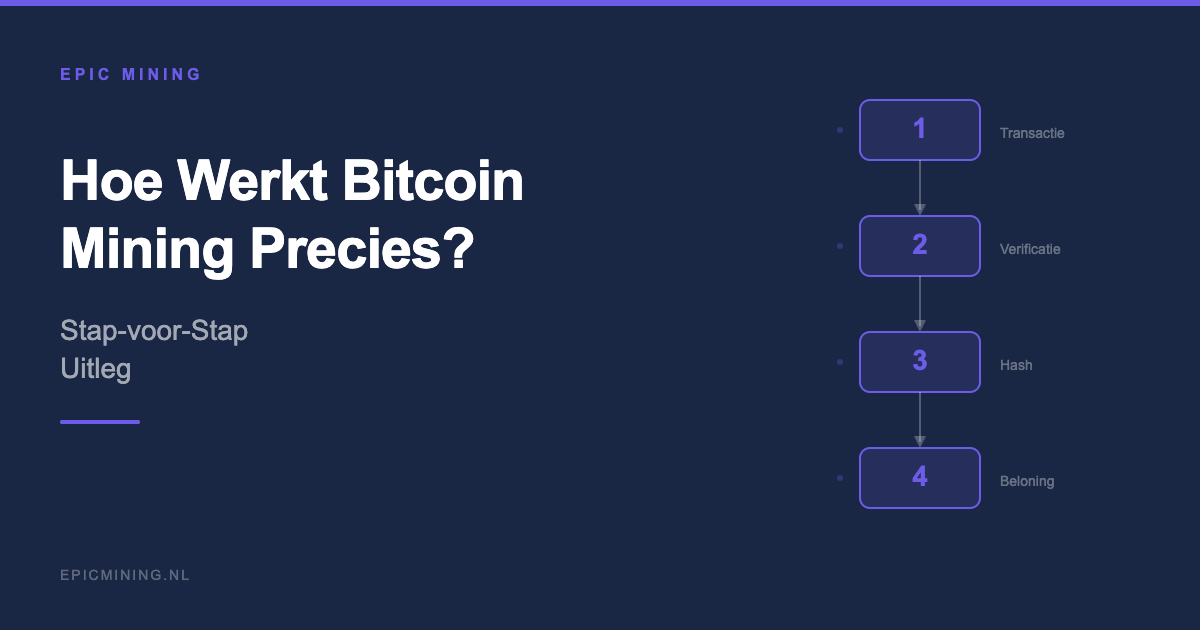
How Does Bitcoin Mining Actually Work? (Step-by-Step Process)

Bitcoin mining is often described in vague terms: “computers solve math problems.” That explanation is technically true but practically useless. Here is exactly what happens inside a mining machine, step by step, in plain language.

What Problem Are Bitcoin Miners Actually Solving?

Bitcoin miners are searching for a specific number. That is it. The entire process boils down to trying billions of numbers per second until one of them, when combined with the block’s data and run through a cryptographic function called SHA-256, produces a result that starts with enough zeros to meet the network’s current target.

There is no equation to solve, no formula to apply, and no shortcut to find. The only way to find the right number is to guess and check. A modern ASIC miner performs 200 trillion guesses per second. The entire network performs over 660 quintillion guesses per second. And still, it takes approximately 10 minutes on average for anyone in the world to find the right answer.

What Is SHA-256 and Why Does Bitcoin Use It?

SHA-256 (Secure Hash Algorithm 256-bit) is a cryptographic hash function. It takes any input (a word, a sentence, an entire book, or a block of transaction data) and produces a fixed-length output: a 64-character hexadecimal string called a hash. The same input always produces the same hash, but even the tiniest change to the input produces a completely different hash.

Key properties of SHA-256: You cannot reverse it (knowing the output does not reveal the input). You cannot predict it (changing one character in the input completely changes the output). You cannot fake it (there is no known way to produce a specific hash without actually running the calculation). These properties are what make Proof of Work possible and what make the blockchain tamper-proof.

What Is the Step-by-Step Mining Process?

Step 1: Transactions Enter the Mempool

When someone sends Bitcoin, their transaction is broadcast to the network and enters the mempool (memory pool), a waiting area for unconfirmed transactions. Every node on the network maintains its own mempool. At any given moment, there may be thousands of transactions waiting to be included in a block.

Step 2: Miners Build a Candidate Block

Each miner selects transactions from the mempool and assembles them into a candidate block. Miners typically prioritize transactions with higher fees, since they keep all fees from the transactions they include. A block can contain up to approximately 4,000 transactions (limited by the 4 MB block weight limit).

Step 3: The Block Header Is Constructed

The miner creates a block header containing six pieces of information.

Field What It Contains Purpose
Version Block format version number Signals which protocol rules apply
Previous block hash Hash of the last confirmed block Links this block to the chain (creates the “chain” in blockchain)
Merkle root Hash representing all transactions in the block Ensures no transactions can be changed without detection
Timestamp Current time Records when the block was created
Difficulty target The number the hash must be below Controls how hard the puzzle is
Nonce A variable number the miner changes This is what miners iterate through to find a valid hash

Step 4: The Hashing Race Begins

The miner hashes the block header through SHA-256 (actually, twice: SHA-256 applied to the SHA-256 output). If the resulting hash is below the difficulty target, the block is valid. If not, the miner increments the nonce by one and tries again. And again. And again. Billions of times per second.

When the nonce space is exhausted (4.3 billion possible values), the miner changes other variables in the block header (like the timestamp or the order of transactions) and starts over. This process continues until a valid hash is found or another miner solves the block first.

660+ EH/s
The entire Bitcoin network makes over 660 quintillion guesses per second and still needs ~10 minutes to find a valid block

Step 5: A Valid Block Is Found

When a miner finds a nonce that produces a hash below the target, they have found a valid block. The miner immediately broadcasts this block to the rest of the network. Other nodes verify the solution (which takes milliseconds, since checking a hash is trivial even though finding it is hard) and add the block to their copy of the blockchain.

Step 6: The Miner Gets Paid

The winning miner receives two forms of payment. First, the block reward: 3.125 BTC of newly created Bitcoin (worth over $300,000 at current prices). Second, all the transaction fees from every transaction included in the block (typically an additional $5,000-50,000 depending on network congestion). These payments are included in a special “coinbase transaction” at the beginning of the block.

Step 7: The Cycle Restarts

As soon as a new block is confirmed, every miner on the network starts building the next candidate block on top of it. The race begins again. This cycle repeats approximately every 10 minutes, 144 times per day, every day of the year.

What Is the Difficulty Adjustment and How Does It Work?

The difficulty adjustment is Bitcoin’s self-regulating mechanism. Every 2,016 blocks (approximately every two weeks), the network automatically adjusts the difficulty target to keep the average block time at 10 minutes.

If blocks are being found faster than every 10 minutes (because more miners have joined), difficulty increases, making the target harder to hit. If blocks are slower (because miners have left), difficulty decreases. This ensures that Bitcoin’s issuance schedule remains predictable regardless of how much mining power is on the network.

Why 10 minutes? The 10-minute target is a design choice by Satoshi Nakamoto that balances speed and security. Faster blocks would confirm transactions sooner but would increase the risk of competing blocks (forks) and reduce security. Slower blocks would be more secure but impractical for a payment network. Ten minutes is the sweet spot that has proven reliable for 17 years.

What Is Proof of Work and Why Does It Matter?

Proof of Work is the consensus mechanism that makes all of this possible. When a miner presents a valid block, they are proving that they expended real computational work (and therefore real electricity) to find it. This proof is embedded in the block hash itself and can be verified by anyone instantly.

The brilliance of Proof of Work is that it ties the security of the blockchain to physical reality. Energy, once spent, cannot be recovered. The work embedded in each block is irreversible, which makes the blockchain itself practically irreversible. This is why Bitcoin has never been hacked: attacking it would require outspending all the energy that every miner in the world has invested. Learn more about this security model in how mining secures the network.

How Do Mining Pools Fit Into This Process?

A single miner with one ASIC machine has an incredibly small chance of finding a block on their own. At 200 TH/s against a network of 660+ EH/s, you would expect to find a block approximately once every 38 years. That is not a viable business.

Mining pools solve this problem. Thousands of miners combine their hash power and work together to find blocks. When the pool finds a block, the reward is distributed proportionally based on each miner’s contribution. Instead of one large payout every 38 years, you receive small daily payments. Read our comparison of solo mining vs pool mining for more detail.

Frequently Asked Questions

Why does mining use so much electricity?

Mining uses electricity because finding a valid block hash requires trillions of SHA-256 calculations per second. Each calculation consumes energy. The more computing power on the network, the harder the puzzle becomes, and the more energy is required. This energy expenditure is what makes the blockchain secure: reversing it would require re-spending all that energy.

What happens if two miners find a block at the same time?

Occasionally, two miners find valid blocks within seconds of each other, creating a temporary fork. The network resolves this naturally: whichever chain gets the next block added to it first becomes the longest chain, and the other block is orphaned. Miners always follow the longest chain. This is why merchants wait for multiple confirmations before considering a payment final.

Can mining difficulty go down?

Yes. If miners leave the network (due to low prices, equipment failure, or regulatory changes), blocks are found slower than every 10 minutes. At the next difficulty adjustment, the target becomes easier. This happened dramatically in mid-2021 when China banned mining and difficulty dropped approximately 28% over several adjustment periods.

How much Bitcoin is created per day?

At the current block reward of 3.125 BTC and approximately 144 blocks per day, roughly 450 BTC is created daily. This amounts to approximately $45 million per day in new Bitcoin at $100,000 per coin. This rate will halve again around 2028 to approximately 225 BTC per day.

Keep Reading

Last updated: 2026-05-09

What Is Bitcoin Mining? A Complete Explanation for Beginners

Bitcoin mining is the process of using specialized computers to validate transactions and create new Bitcoin. It is how the Bitcoin network stays secure, how transactions get confirmed, and how new coins enter circulation. If you want to understand Bitcoin, you need to understand mining.

What Is Bitcoin Mining?

Bitcoin mining is the process by which new Bitcoin is created and transactions are verified on the Bitcoin network. Miners use powerful computers to solve complex mathematical puzzles. The first miner to solve the puzzle earns the right to add a new block of transactions to the blockchain and receives a reward of newly minted Bitcoin.

The term “mining” is an analogy to gold mining. Just as gold miners expend energy and resources to extract gold from the earth, Bitcoin miners expend electricity and computing power to produce new Bitcoin. The key difference is that Bitcoin mining also serves as the security mechanism for the entire network. Every miner who participates makes the network more secure and harder to attack.

Why Does Bitcoin Need Miners?

Bitcoin has no central authority. There is no bank verifying transactions, no government issuing currency, and no company running the network. Miners fill all of these roles simultaneously. They verify that transactions are legitimate (you actually own the Bitcoin you are trying to send), they process and record transactions in the blockchain, and they create new Bitcoin as a reward for this work.

Without miners, the Bitcoin network would stop functioning entirely. No transactions would be confirmed. No new blocks would be added to the blockchain. No new Bitcoin would be created. Miners are the backbone of how Bitcoin works.

Three jobs, one process: Mining simultaneously accomplishes three things: (1) it creates new Bitcoin, (2) it verifies and records transactions, and (3) it secures the network against attacks. No other system in finance combines money creation, transaction processing, and security into a single operation.

How Does Bitcoin Mining Work?

The mining process follows a cycle that repeats approximately every 10 minutes.

Step What Happens Why It Matters
1. Transactions broadcast Users send Bitcoin, and their transactions enter a waiting area (mempool) Every Bitcoin transaction needs to be included in a block
2. Miners collect transactions Each miner selects transactions from the mempool to include in their candidate block Transactions with higher fees are prioritized
3. Miners compete Miners race to solve a cryptographic puzzle (finding a hash below a target number) This is the Proof of Work that secures the network
4. Winner found The first miner to find a valid solution broadcasts it to the network Other miners verify the solution in milliseconds
5. Block added The winning miner’s block is added to the blockchain All transactions in the block are now confirmed
6. Reward paid The winning miner receives the block reward (3.125 BTC) plus transaction fees This is how miners earn revenue

The “puzzle” miners solve is not a math problem in the traditional sense. It is a brute-force search for a number that, when combined with the block’s data and run through a cryptographic function (SHA-256), produces a result below a certain target. There is no shortcut. The only way to find the answer is to try billions of possibilities until one works. This is why mining requires so much computing power. For the full technical breakdown, read how Bitcoin mining actually works.

3.125 BTC
Current block reward per mined block (worth over $300,000 at today’s prices)

What Equipment Do You Need to Mine Bitcoin?

In Bitcoin’s early days (2009-2012), you could mine with a regular laptop or desktop computer. Those days are long gone. Today, Bitcoin mining requires specialized hardware called ASIC miners (Application-Specific Integrated Circuits). These are machines designed to do one thing only: perform SHA-256 hash calculations as fast and efficiently as possible.

A modern ASIC miner like the Antminer S21 performs 200 trillion hash calculations per second (200 TH/s) while consuming 3,500 watts of electricity. It costs approximately $3,500-5,000 and generates significant noise (around 75 decibels, similar to a vacuum cleaner) and heat.

Hardware Type Hash Rate Status in 2026
CPU (regular computer) ~10 MH/s Completely obsolete since 2011
GPU (graphics card) ~800 MH/s Obsolete for Bitcoin since 2013
FPGA ~1 GH/s Obsolete since 2013
ASIC (current gen) 200-234 TH/s Required for profitable mining

Is Bitcoin Mining Profitable?

Yes, Bitcoin mining is profitable in 2026 when done correctly. The key variables are your electricity cost, your hardware efficiency, and the current Bitcoin price. Mining is essentially a business where your product (Bitcoin) has a market price and your main input cost is electricity.

At current difficulty and Bitcoin prices, a single Antminer S21 with electricity at 6 to 7 cents per kWh generates approximately $150-350 per month in net profit after electricity costs. The exact amount fluctuates with Bitcoin’s price and network difficulty. For a detailed profitability analysis, see is Bitcoin mining still profitable in 2026.

The mining advantage: Mining lets you acquire Bitcoin at below-market cost. If your all-in cost to produce one Bitcoin is $40,000-60,000 and Bitcoin trades at $100,000+, you are effectively buying Bitcoin at a 40-60% discount. This is why producing Bitcoin can be more attractive than simply buying it on an exchange.

What Are the Different Ways to Mine Bitcoin?

Home Mining

Running an ASIC miner in your home. The main challenges are noise (75+ dB), heat output (equivalent to a space heater running 24/7), high residential electricity rates ($0.12-0.30/kWh in most areas), and the need for 240V electrical circuits. Home mining can work in specific situations but is impractical for most people. Read the full analysis in can you mine Bitcoin at home.

Hosted Mining

You purchase your own ASIC miner, and a professional facility operates it for you. The facility provides cheap industrial electricity (6 to 7 cents per kWh), cooling, maintenance, and 24/7 monitoring. You own the hardware, control the mining pool, and receive all the Bitcoin. This is the most accessible and cost-effective option for most new miners. Learn more about hosted mining.

Pool Mining

Individual miners combine their computing power in a mining pool to increase their chances of finding blocks. When the pool finds a block, the reward is split proportionally based on each miner’s contributed hash rate. Nearly all miners use pools because solo mining with a single machine would mean waiting months or years between payouts.

How Much Energy Does Bitcoin Mining Use?

Bitcoin mining uses a significant amount of electricity globally, estimated at approximately 150-170 TWh per year in 2026. This is comparable to the electricity consumption of a mid-sized country. However, this energy consumption is what secures a $2+ trillion monetary network that serves hundreds of millions of users worldwide.

An increasing share of Bitcoin mining uses renewable or stranded energy sources. Many miners specifically seek out locations with excess hydroelectric, wind, solar, or geothermal power that would otherwise go to waste. Learn more about Bitcoin mining and renewable energy and how mining helps solve the stranded energy problem.

Frequently Asked Questions

Can I mine Bitcoin on my phone or laptop?

No. Bitcoin mining requires specialized ASIC hardware. A phone or laptop would earn a fraction of a penny per year in Bitcoin while consuming more in electricity than it produces. Any app or website claiming you can mine Bitcoin on your phone is either a scam or mining a different, much less valuable cryptocurrency.

How long does it take to mine one Bitcoin?

With a single Antminer S21 (200 TH/s), it takes approximately 2-3 years on average to accumulate one full Bitcoin through pool mining. However, you receive small daily payouts rather than waiting for a full coin. Most pool miners receive payouts daily, regardless of how small.

Is Bitcoin mining legal?

Bitcoin mining is legal in most countries, including the United States, Canada, the European Union, and most of South America. A few countries have banned or restricted mining, including China (since 2021). Always check your local regulations before starting a mining operation.

Do I need technical knowledge to mine Bitcoin?

With hosted mining, no. The hosting facility handles all technical aspects: hardware setup, pool configuration, monitoring, and maintenance. You purchase a miner, choose a hosting provider, and start receiving Bitcoin. It is comparable in complexity to opening an investment account.

What is the block reward and how does it change?

The block reward is the amount of new Bitcoin given to the miner who successfully adds a block to the blockchain. It started at 50 BTC in 2009 and halves approximately every four years. The current reward is 3.125 BTC per block (since April 2024). The next halving, around 2028, will reduce it to 1.5625 BTC.

Keep Reading

Last updated: 2026-05-09

What Gives Bitcoin Its Value? The Economics Explained

Bitcoin has no CEO, no headquarters, no army, and no gold reserves. Yet it is worth over $100,000 per coin and commands a market capitalization exceeding $2 trillion. Understanding what gives Bitcoin its value is essential before you mine it, buy it, or dismiss it.

What Makes Bitcoin Valuable?

Bitcoin derives its value from a combination of properties that no other asset in history has possessed simultaneously: absolute scarcity, perfect portability, censorship resistance, and a decentralized network that no one can control or shut down. These are not marketing claims. They are verifiable technical properties enforced by mathematics and a global network of computers.

Value is not the same as price. Price is what people pay on a given day. Value is the underlying set of properties that make something worth paying for. Bitcoin’s value proposition is that it is the first asset in human history with a provably fixed supply that can be sent to anyone, anywhere, without permission from any authority.

Why Does Scarcity Matter?

There will only ever be 21 million Bitcoin. This limit is hardcoded into the protocol and enforced by every node on the network. No government, company, or group of developers can change it. Approximately 19.8 million Bitcoin have already been mined, with the remaining 1.2 million to be released through mining over the next century.

Scarcity alone does not create value. Plenty of things are scarce but worthless. What makes Bitcoin’s scarcity valuable is that it is combined with utility. Bitcoin is the only scarce digital asset that is also globally liquid, easily divisible, and practically impossible to counterfeit.

Asset Total Supply Annual Inflation Rate Supply Controlled By
Bitcoin 21 million (fixed) ~0.8% (decreasing to 0%) Mathematical code (no one)
Gold ~205,000 tonnes above ground ~1.5% Mining companies, geology
U.S. Dollar Unlimited ~3-8% (historically) Federal Reserve
Euro Unlimited ~2-10% European Central Bank
21M
The maximum number of Bitcoin that will ever exist. No exceptions, no overrides, no emergency printing.

How Does the Network Effect Drive Bitcoin’s Value?

Bitcoin becomes more valuable as more people use it. This is called the network effect, and it is the same force that made the telephone, the internet, and social media platforms increasingly useful as adoption grew.

Every new user, every new merchant that accepts Bitcoin, every new exchange that lists it, and every new institution that holds it on its balance sheet strengthens the network. More participants mean more liquidity, more infrastructure, more development, and more resilience. Bitcoin’s network effect has been compounding for 17 years and shows no sign of slowing.

The adoption flywheel: Higher prices attract more users. More users attract more developers building tools. Better tools attract more merchants. More merchants attract more users. This self-reinforcing cycle has driven Bitcoin from $0 to over $100,000, and it is the same reason early adoption creates outsized returns.

What Is Bitcoin’s Stock-to-Flow Ratio?

Stock-to-flow (S2F) is a ratio that measures scarcity by comparing the existing supply (stock) to the annual production rate (flow). A higher ratio means greater scarcity. Gold’s S2F is approximately 60, meaning it would take 60 years of current mining production to double the existing supply. Bitcoin’s current S2F is approximately 120 after the 2024 halving, making it twice as scarce as gold by this measure.

After each halving, Bitcoin’s flow is cut in half while the stock continues to grow. This means Bitcoin’s stock-to-flow ratio doubles approximately every four years, making it progressively scarcer in a way that no other asset can replicate.

Why Do People Compare Bitcoin to Gold?

Bitcoin shares gold’s key monetary properties: scarcity, durability, and fungibility. But Bitcoin improves on gold in several critical ways.

Property Bitcoin Gold
Scarcity Absolute (21M cap, mathematically enforced) Relative (new deposits found, asteroid mining possible)
Portability Send $1B in minutes for under $5 Heavy, expensive to transport and insure
Divisibility Divisible to 0.00000001 BTC Difficult to split into small amounts
Verifiability Instant cryptographic verification Requires assaying (testing for purity)
Storage cost Free (just secure your keys) Vaults, insurance, security
Seizure resistance Can memorize your keys (brain wallet) Physical, can be confiscated
Track record 17 years 5,000+ years

The comparison to gold is not a marketing gimmick. It reflects a genuine similarity in monetary function, combined with technological improvements that make Bitcoin a superior version of the same concept: a store of value that cannot be debased by any authority.

What Role Does Mining Play in Bitcoin’s Value?

Mining creates a production cost floor for Bitcoin. Every Bitcoin that enters circulation required real energy expenditure to produce. This is not unlike gold, where the cost of extraction sets a baseline for the metal’s price.

In 2026, the average cost to mine one Bitcoin at industrial electricity rates is approximately $40,000-60,000, depending on hardware efficiency and energy costs. This does not guarantee that Bitcoin trades above this level, but it does mean that miners (who are rational economic actors) will reduce or cease production if the price falls significantly below their cost, which reduces supply and supports the price.

For individual miners, this dynamic creates an opportunity. If you can produce Bitcoin at below-market cost through efficient hardware and low electricity rates, you are effectively buying Bitcoin at a discount. This is the core appeal of hosted mining and why many investors choose to mine rather than buy on exchanges. See our comparison in buying vs producing Bitcoin.

How Does Institutional Adoption Affect Bitcoin’s Value?

Institutional adoption has been one of the most significant drivers of Bitcoin’s value growth. When major corporations and financial institutions buy Bitcoin, they bring credibility, liquidity, and demand that pushes prices higher.

The approval of spot Bitcoin ETFs in January 2024 was a watershed moment. It gave traditional investors easy access to Bitcoin through their existing brokerage accounts, without needing to manage wallets or private keys. Within two years, Bitcoin ETFs accumulated over $100 billion in assets. For a full list of companies and institutions holding Bitcoin, read our article on institutional Bitcoin adoption.

Frequently Asked Questions

Is Bitcoin a bubble?

Bitcoin has experienced multiple boom-and-bust cycles, each of which has been called a bubble. However, after each crash, Bitcoin has recovered to new highs and maintained a higher baseline of adoption, infrastructure, and institutional participation. A 17-year bubble that keeps recovering would be unprecedented in financial history.

What happens to Bitcoin’s value if everyone stops buying?

Like any market asset, Bitcoin’s price is determined by supply and demand. If demand dropped to zero, the price would fall. However, Bitcoin’s fixed supply means that even modest demand supports a meaningful price. The network’s utility (borderless payments, censorship resistance, store of value) provides a baseline demand floor that grows with adoption.

Does Bitcoin have intrinsic value?

Bitcoin has intrinsic utility value: it provides a censorship-resistant, borderless payment network that operates without intermediaries. Whether this constitutes \”intrinsic value\” depends on your definition. Gold’s intrinsic value is primarily industrial (jewelry, electronics), but its market price far exceeds its industrial utility. The same is true for Bitcoin: its value comes from its monetary properties, not from being a physical commodity.

Can another cryptocurrency replace Bitcoin?

Theoretically possible, but historically unlikely. Bitcoin has the largest network effect, the most liquidity, the most institutional adoption, and the most battle-tested security of any cryptocurrency. Its 17-year track record of continuous operation without a single successful attack is an asset that cannot be replicated by a new competitor starting from zero.

Keep Reading

Last updated: 2026-05-09