icon New mining location added: Finland More information

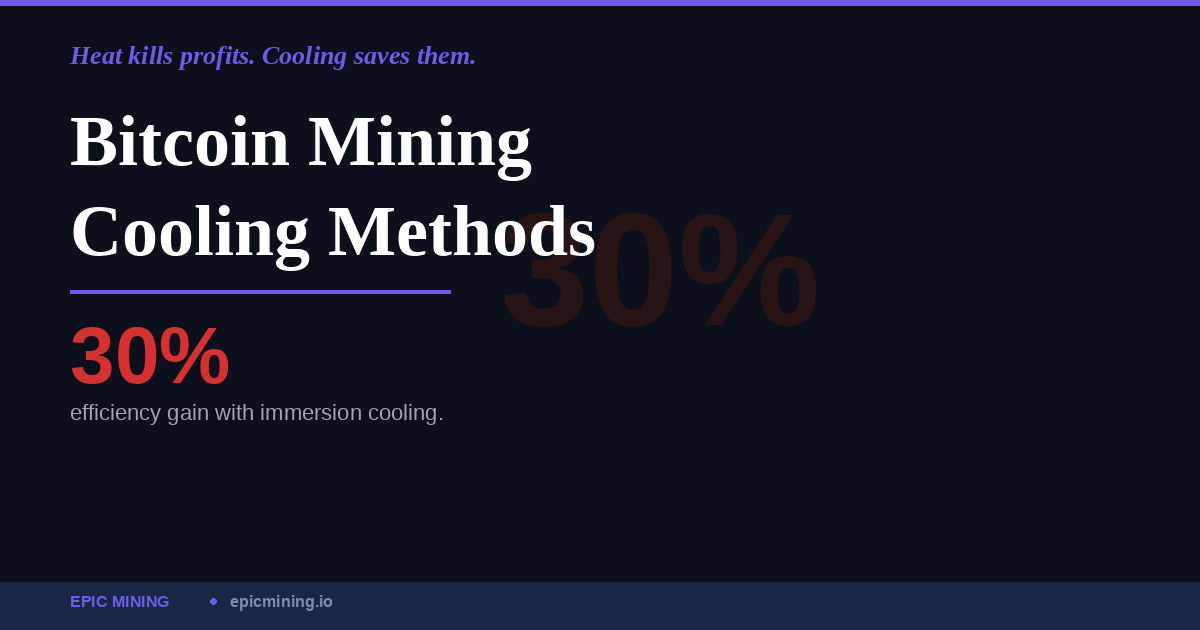
Bitcoin Mining Cooling Methods: Air, Water, and Immersion

A miner that overheats throttles performance and dies early. Cooling is not optional. It is the difference between a profitable machine and an expensive paperweight.

Why Cooling Matters

Every watt of electricity your miner consumes becomes heat. A 3,500 watt ASIC produces the same thermal output as a large space heater running around the clock. In a facility with hundreds or thousands of machines, that heat accumulates fast.

If the ambient temperature around a miner rises too high, the machine throttles its hashrate to protect itself. That means less Bitcoin production. In extreme cases, sustained high temperatures damage hash boards permanently, turning a $5,000 investment into scrap metal.

Effective cooling is not a nice to have. It is a core requirement that directly impacts your profitability. The best mining operations treat cooling infrastructure as seriously as power procurement.

Air Cooling: The Standard Approach

Air cooling is the most common method in Bitcoin mining. Large industrial fans push ambient air across the machines, drawing heat away from the components. Facilities are designed with hot aisle and cold aisle configurations to maximize airflow efficiency.

Pros: lowest upfront cost, simplest to implement, easy maintenance, and proven at scale. Most of the world’s largest mining operations use air cooling.

Cons: effectiveness drops in hot climates, requires large physical footprints for airflow, fans consume additional electricity, and dust and humidity can damage machines over time. In regions where summer temperatures exceed 35C (95F), air cooling alone may be insufficient.

Immersion Cooling: The Premium Option

Immersion cooling submerges miners entirely in a non conductive liquid (typically a synthetic dielectric fluid). The liquid absorbs heat directly from the components, far more efficiently than air. This allows machines to run at lower temperatures and higher efficiency.

Pros: 20% to 30% efficiency improvement, eliminates fan noise entirely, reduces mechanical failure (no fans to break), allows overclocking for higher hashrate, and extends hardware lifespan significantly.

Cons: highest upfront cost (tanks, fluid, heat exchangers), more complex maintenance, specialized knowledge required, and the dielectric fluid itself is expensive. Immersion cooling makes economic sense at scale but is rarely practical for single machine deployments.

Which Method Is Best for You?

For individual miners using hosted mining, you do not need to choose. The hosting facility has already invested in the optimal cooling infrastructure for their climate and scale. Your machine benefits from professional grade cooling without you managing any of it.

If you are mining at home, air cooling with a well ventilated garage or workshop is the practical option. Immersion cooling is rarely worth the investment for fewer than 10 machines.

At a facility level, the best operations match their cooling strategy to their climate. Hot climate facilities invest more heavily in immersion or evaporative systems. Cold climate facilities in Scandinavia or Canada leverage ambient air naturally and run some of the most efficient operations in the world.

30%
efficiency improvement possible with immersion cooling vs standard air cooling

Frequently Asked Questions

What is the best cooling method for Bitcoin mining?

Air cooling is the most widely used and cost effective for most operations. Immersion cooling offers 20% to 30% better efficiency but at significantly higher upfront cost. The best choice depends on climate, scale, and budget. Hosted mining facilities handle cooling for you.

What is immersion cooling?

Immersion cooling submerges Bitcoin miners in a non conductive liquid that absorbs heat directly from components. It eliminates fan noise, reduces mechanical failures, and allows machines to run at higher performance. It is the premium cooling option used by advanced operations.

Does heat damage Bitcoin miners?

Yes. Sustained high temperatures cause miners to throttle performance, reducing Bitcoin output. Extreme heat can permanently damage hash boards. Proper cooling extends hardware lifespan and maintains peak performance.

How do large mining facilities stay cool?

Most use industrial air cooling with hot aisle and cold aisle configurations. Some use evaporative cooling, water cooling, or immersion cooling depending on climate and scale. Facilities in cold climates have a natural advantage.

Keep Reading

Last updated: 2026-04-12

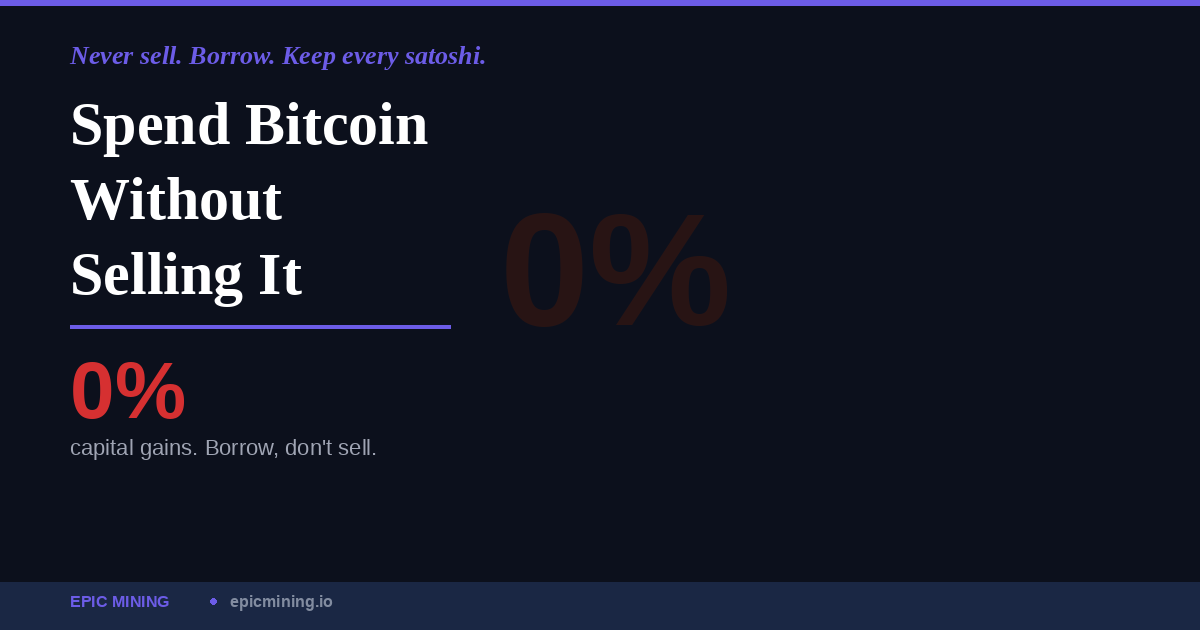
How to Spend Bitcoin Without Selling It

The ultra wealthy never sell appreciating assets. They borrow against them. Here is how you do the same thing with your mined Bitcoin.

Why Selling Is the Wrong Move

Every time you sell Bitcoin, two things happen. First, you trigger a capital gains tax event. Depending on your jurisdiction and holding period, that can cost you 15% to 37% of your gains. Second, you permanently reduce your Bitcoin position. You lose the future upside of every satoshi you sold.

If you believe Bitcoin will be worth more in 5 to 10 years than it is today (and all historical evidence supports this), selling is the most expensive way to access your wealth.

The alternative is borrowing. Use your Bitcoin as collateral for a fiat loan. Spend the loan. Keep the Bitcoin. No tax event. No lost upside.

How Bitcoin Backed Loans Work

The concept is simple. You deposit Bitcoin as collateral with a lending platform. They give you a fiat loan, typically 30% to 50% of your Bitcoin’s value (the loan to value ratio). You pay interest on the loan and use the cash however you want.

Example: You have $100,000 in Bitcoin. You take a $40,000 loan at 40% LTV and 8% annual interest. Your yearly interest cost is $3,200. Meanwhile, if Bitcoin appreciates 20%, your collateral grows to $120,000 and you still own every satoshi.

Compare that to selling $40,000 of Bitcoin. You pay $6,000 to $10,000 in capital gains tax and permanently lose those coins. The math strongly favors borrowing over selling.

The Platforms

Several platforms offer Bitcoin backed loans. Unchained Capital specializes in Bitcoin only lending with multisig custody. Ledn offers competitive rates with institutional grade custody. Some traditional brokerages are beginning to offer Bitcoin collateral lending.

Key factors to evaluate: interest rate (6% to 12% is typical), loan to value ratio (40% to 50% is standard), custody arrangement (who holds the Bitcoin during the loan), and liquidation terms (at what price level your collateral gets sold).

Always understand the liquidation risk. If Bitcoin’s price drops significantly, you may need to add more collateral or your position gets liquidated. Manage your LTV ratio conservatively to avoid this.

Using Loans Strategically

The most powerful use of Bitcoin backed loans for miners is funding additional machines. Borrow against your accumulated BTC to buy more miners. The new machines produce more Bitcoin, which grows your collateral, which lets you borrow more. This is how miners scale without selling.

Other uses: covering living expenses during bear markets without selling at low prices, funding a down payment on a home, or paying for large purchases without reducing your Bitcoin position.

The key discipline is borrowing conservatively. Keep your loan to value ratio below 40%. Have a plan to repay or add collateral if Bitcoin drops 30%. Used responsibly, Bitcoin backed lending is a powerful wealth building tool.

$0 in Taxes
when you borrow against Bitcoin instead of selling. Keep every satoshi. Access your wealth tax free.

Frequently Asked Questions

How do I spend Bitcoin without selling?

Use your Bitcoin as collateral for a fiat loan. Lending platforms give you cash at 30% to 50% of your Bitcoin’s value. You pay interest on the loan and keep all your Bitcoin. No sale means no capital gains tax.

What is the risk of a Bitcoin backed loan?

The main risk is liquidation. If Bitcoin’s price drops below a threshold, the lender may sell your collateral. Manage this by keeping your loan to value ratio conservative (below 40%) and having a plan to add collateral if needed.

What interest rate do Bitcoin loans charge?

Typical rates range from 6% to 12% annually depending on the platform, LTV ratio, and loan size. This is generally less than the capital gains tax you would pay by selling Bitcoin.

Can miners use loans to buy more machines?

Yes. Borrow against accumulated Bitcoin to fund additional machine purchases. The new machines produce more Bitcoin, growing your collateral. This is how experienced miners scale without selling their holdings.

Keep Reading

Last updated: 2026-04-12

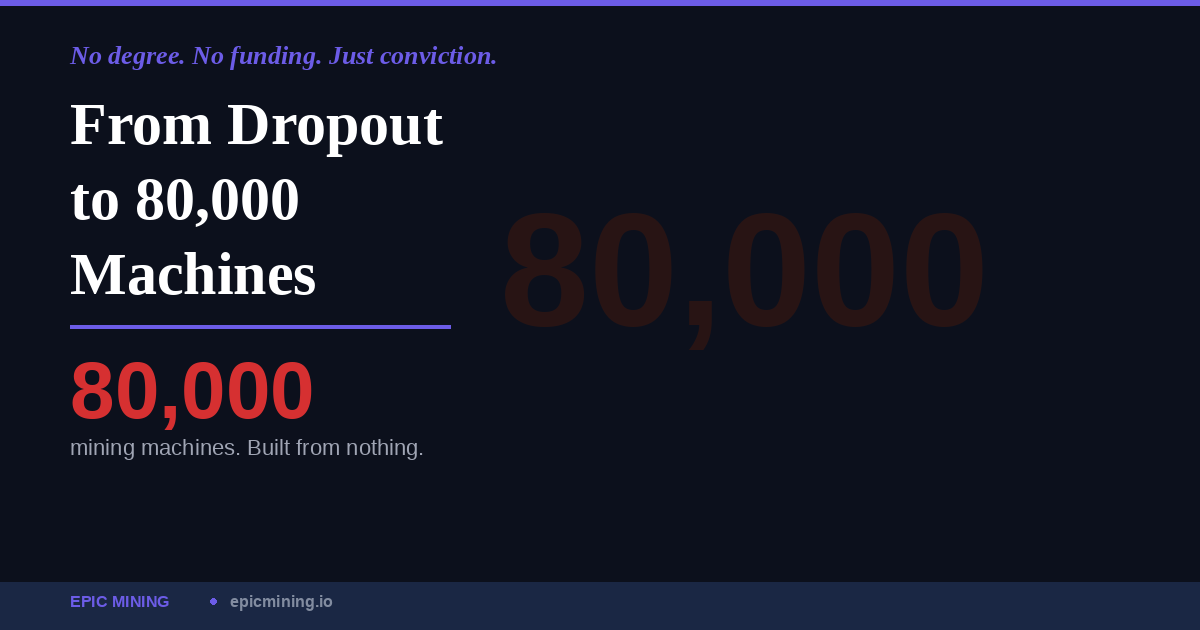
From Dropout to 80,000 Mining Machines

No degree. No venture capital. No connections. Just one belief: if you can turn electricity into money, nothing else matters. Here is how Epic Mining got built.

The Moment Everything Changed

Most people hear about Bitcoin and think about buying it on an app. Mitchell heard about Bitcoin and thought about producing it. Not trading it. Not speculating. Producing it. Like a factory that runs 24 hours a day, turning raw electricity into the hardest money ever created.

That single insight, that you could manufacture Bitcoin instead of buying it, became the foundation of Epic Mining. What started with a handful of machines in a small facility grew into one of the largest mining operations in the industry, running over 80,000 ASIC miners across multiple locations.

No family money. No MBA. No pitch decks for Silicon Valley VCs. Just a deep understanding of energy economics and an obsession with building something real.

The Early Days

The first facility was not glamorous. It was loud, hot, and constantly breaking down. The early days of mining are brutal for everyone. Machines overheat. Power supplies fail. Internet connections drop. The difference between people who succeed in mining and those who quit is simple: the ones who succeed keep their machines running.

That operational discipline became the core of Epic Mining. Every problem was a system to be solved. Cooling, maintenance, monitoring, power negotiation. One by one, each problem became a competitive advantage.

The facilities got bigger. The power contracts got cheaper. The machines got better. And the operation scaled from hundreds to thousands to tens of thousands of machines.

Why This Matters for You

You do not need 80,000 machines to benefit from Bitcoin mining. But the infrastructure that was built to run those machines is now available to individual miners through hosted mining.

That means you can own a miner that sits inside a facility with institutional electricity rates, professional maintenance, and industrial cooling. You do not deal with the noise, the heat, or the complexity. You own the machine. You keep the Bitcoin.

This is what Epic Mining built: the bridge between individual miners and institutional mining infrastructure. The same power rates, the same uptime, the same operational excellence, but accessible to anyone who wants to start producing Bitcoin.

The Conviction That Drives It All

Bitcoin mining is not just a business. It is a belief system. It is the conviction that sound money matters, that individuals deserve access to the tools that institutions use, and that the best way to acquire Bitcoin is to produce it yourself.

80,000 machines later, that conviction has not changed. What has changed is that the tools, the infrastructure, and the opportunity are now available to you. You do not need to be a dropout or a visionary. You just need to start.

Here is how to get your first miner running in 7 days.

80,000+
Bitcoin mining machines running 24/7, built from a single insight about producing vs buying

Frequently Asked Questions

How did Epic Mining start?

Epic Mining started with a small number of machines in a single facility. The founder recognized that producing Bitcoin through mining was more effective than buying it on an exchange. That insight drove the operation’s growth from hundreds of machines to over 80,000.

Do I need a large facility to mine Bitcoin?

No. Through hosted mining, you can own a machine that operates inside an industrial facility with institutional electricity rates. You do not need to manage the hardware, deal with noise or heat, or negotiate power contracts. You own the miner and keep all the Bitcoin it produces.

What is hosted mining?

Hosted mining means your mining machine is located in a professional facility managed by a company like Epic Mining. The facility handles electricity, cooling, maintenance, and monitoring. You own the hardware and receive the Bitcoin it produces directly to your wallet.

Can one person compete with large mining operations?

Through hosted mining, yes. Individual miners get access to the same electricity rates, cooling systems, and uptime that large operations use. The difference is scale, not efficiency. A single machine in a well run facility produces Bitcoin at the same cost per unit as ten thousand machines.

Keep Reading

Last updated: 2026-04-12

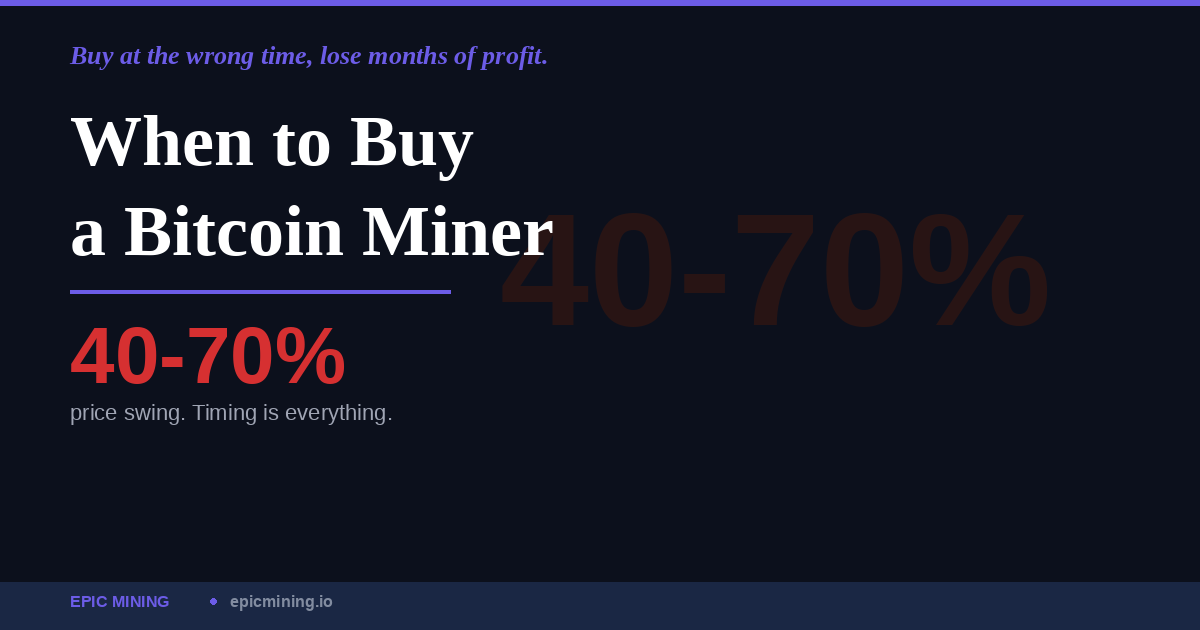
When to Buy a Bitcoin Miner (and When to Wait)

ASIC miner prices swing 40% to 70% depending on the Bitcoin cycle. The difference between buying at the right time and the wrong time is months of additional profit.

Miner Prices Follow the Bitcoin Cycle

Bitcoin miner prices are not set by manufacturing cost. They are set by demand. When Bitcoin is rallying and mining is profitable, everyone wants machines. Prices spike. When Bitcoin is in a bear market, machines sit in inventory. Prices drop.

This cycle creates a predictable pattern. Buy during accumulation and bear markets when machines are cheap. Avoid buying during euphoria when machines are marked up 40% to 70% above fair value.

The Signals to Buy

Bitcoin price is flat or slowly recovering from a correction. Media attention on mining is low. Machine vendors are offering discounts and incentives. Delivery times are immediate (no backlog).

If you see these signals, it is a buying opportunity. The combination of cheap hardware and upcoming price appreciation creates the highest ROI conditions.

The months immediately before and after a halving are typically the sweet spot. Hardware prices have not yet responded to the coming supply shock.

The Signals to Wait

Bitcoin is making new all time highs. Social media is flooded with mining content. Vendors have multi month waitlists. Machines are priced 40% to 70% above what they cost six months ago.

Buying during euphoria means paying peak prices for hardware that will depreciate when the market cools. Your ROI timeline stretches from months to years. In the worst case, the machine never pays for itself.

Patience during euphoria is one of the hardest but most important disciplines in mining. The bear market always comes, and with it, better hardware deals.

Dollar Cost Average Your Hardware

If you are unsure about timing, borrow a concept from Bitcoin investing: dollar cost averaging. Instead of buying 10 machines at once, buy 2 to 3 at a time over several months. This spreads your entry across different market conditions.

This approach is particularly effective in the middle of the cycle when direction is unclear. You will not get the absolute best price, but you will avoid the absolute worst.

A systematic approach to hardware acquisition is always better than an emotional one.

40% to 70%
price swing in ASIC miners between cycle lows and cycle highs. Timing your purchase matters.

Frequently Asked Questions

When is the best time to buy a Bitcoin miner?

During the accumulation phase or bear market, when hardware is cheapest. Signs include flat Bitcoin prices, low media attention, vendor discounts, and immediate delivery. The months around a halving are typically optimal.

How much do miner prices fluctuate?

ASIC miner prices typically swing 40% to 70% between cycle lows and highs. A machine that costs $4,000 in a bear market might cost $6,000 to $7,000 during a bull market.

Should I buy multiple miners at once?

Consider dollar cost averaging by buying machines over time rather than all at once. This spreads your entry price across different market conditions and reduces the risk of buying at a cycle peak.

What machines should I buy?

Current generation ASICs with the best joules per terahash efficiency. As of 2026, the Antminer S21 series and Whatsminer M60 series lead the market. Buy from authorized dealers or reputable hosting providers.

Keep Reading

Last updated: 2026-04-12

Where Individual Miners Fit in the Industry

The mining industry looks like it is only for big players with warehouses and power plants. It is not. Here is exactly where you fit in and why the economics work.

The Myth of Scale Requirements

When most people think about Bitcoin mining, they picture massive facilities with rows of machines stretching to the horizon. That image is accurate for some operators, but it misrepresents who actually profits from mining. You do not need scale to be profitable. You need cheap electricity and efficient hardware.

A single machine running at 6 to 7 cents per kWh produces Bitcoin at the same cost per coin as ten thousand machines running at the same rate. The cost advantage comes from the electricity rate, not the number of machines.

This is why individual miners using hosted facilities compete on identical economic terms with the largest public mining companies. The electricity rate is the equalizer.

The Individual Miner Advantage

Large mining companies have overhead that individuals do not: executive salaries, office leases, compliance teams, investor relations departments, and stock based compensation. All of that cost comes out of their mining margins.

As an individual miner, your total cost is the machine plus the electricity and hosting fee. There is no corporate overhead eating into your returns. Dollar for dollar, an individual miner at a well run hosting facility can achieve better net margins than a publicly traded mining company.

You also have flexibility. You can sell your machine at any time. You have no debt covenants. No quarterly earnings pressure. You make decisions based purely on the economics, not on what the stock market wants to see.

How Hosting Works for Individuals

The process is straightforward. You purchase a mining machine (typically $3,000 to $8,000 for current generation hardware). The hosting provider installs it in their facility, provides electricity at institutional rates, handles cooling and maintenance, and monitors the machine 24/7.

Bitcoin is deposited directly into your wallet. The hosting fee covers electricity and facility costs. Your net return is the Bitcoin produced minus the hosting fee. At current conditions, that net return provides strong monthly cash flow and full ROI within 8 to 14 months.

Getting started takes about 7 days from purchase to first Bitcoin in your wallet. No technical background required.

Your Place in the Ecosystem

Individual miners serve a crucial role in the Bitcoin network. They decentralize hashrate, which strengthens the network against censorship and attack. Every individual who runs a miner, even just one, makes Bitcoin more resilient.

Beyond the ideological value, the financial opportunity is real. You produce Bitcoin at below market cost. You own a physical asset (the machine) that has resale value. You accumulate BTC every single day without timing the market.

The mining industry is big, but there is room for everyone. Start with one machine. Scale when the economics prove themselves. That is how most of the largest operations started.

1 Machine
is all you need to start producing Bitcoin on the same economic terms as the largest mining operations

Frequently Asked Questions

Can one person mine Bitcoin profitably?

Yes. A single machine at a hosted facility with 4 to 5 cent electricity produces Bitcoin at the same unit cost as a facility with 10,000 machines. Profitability depends on electricity rate and hardware efficiency, not scale.

How much does it cost to start mining Bitcoin?

A current generation ASIC miner costs $3,000 to $8,000. Monthly hosting fees (electricity plus facility) run $100 to $200 depending on the provider and power rate. Total startup cost is comparable to a used car.

Do individual miners compete with large companies?

Yes, and often with better net margins. Large mining companies carry overhead costs like executive salaries, office leases, and compliance teams. Individual miners have no such overhead, so their net return per machine can be higher.

What is the minimum investment for Bitcoin mining?

You can start with a single machine for $3,000 to $5,000 for mid tier hardware or $6,000 to $8,000 for top tier. Add first and last month hosting, and total startup is roughly $3,500 to $8,500.

Keep Reading

Last updated: 2026-04-12

The Best Energy Sources for Bitcoin Mining

The energy source powering your miner determines your profit margin. Here is every major option compared on cost, reliability, and access.

Why Energy Source Matters

In Bitcoin mining, your energy source determines your floor cost. Everything above that floor is profit. A miner running on $0.065 stranded gas has completely different economics than one running on $0.10 grid power.

But cost is not the only factor. Reliability matters because downtime kills revenue. Availability matters because you need power 24/7, not just when the sun shines. The ideal energy source is cheap, reliable, and always on.

Stranded Natural Gas

Stranded gas is natural gas that would otherwise be flared or vented at oil well sites. Mining operations convert this waste gas into electricity onsite using generators, producing power at 1 to 6.5 cents per kWh.

This is the cheapest electricity available anywhere in the mining industry. The downside is remote locations, generator maintenance, and variable gas supply. It is ideal for large mobile mining operations but not practical for individual miners.

Hydroelectric Power

Hydro is the gold standard for clean, cheap, reliable baseload power. Rates of 3 to 6.5 cents per kWh are common near hydroelectric dams in the Pacific Northwest, Quebec, Scandinavia, and parts of South America.

Hydro facilities produce power 24/7 regardless of weather. The environmental profile is excellent. Many of the world’s most established mining operations run on hydro. This is where many hosted mining facilities are located.

Nuclear Power

Nuclear is emerging as a major power source for Bitcoin mining. Nuclear plants produce cheap, reliable baseload power at 3 to 6.5 cents per kWh with zero carbon emissions. Several mining companies have signed power purchase agreements with nuclear facilities.

Nuclear’s advantage is scale and reliability. A single plant can power millions of miners. It runs 24/7 regardless of weather. The industry is moving toward nuclear as a primary power source for large scale operations.

Wind and Solar

Renewable energy from wind and solar is abundant and cheap when producing (1 to 6.5 cents per kWh in good conditions). The challenge is intermittency: the sun sets, and the wind stops. Bitcoin mining requires 24/7 operation for optimal economics.

Some operations pair renewables with battery storage or grid backup to maintain uptime. Others use mining as a flexible load that absorbs excess renewable production and shuts down during peak demand. This model is gaining traction and makes economic sense in certain regions.

What This Means for Individual Miners

As an individual, you do not choose the energy source directly. You choose the hosting facility, and they have already optimized their energy procurement. The best facilities run on hydro, nuclear, or stranded gas at 3 to 6.5 cents per kWh.

When evaluating hosting providers, ask about their power source and rate. The answer tells you almost everything about whether your mining will be profitable. Start here to find facilities with competitive rates.

$0.065 to $0.065
per kWh from stranded gas, hydro, and nuclear, the energy sources that power profitable mining

Frequently Asked Questions

What is the cheapest energy for Bitcoin mining?

Stranded natural gas at 1 to 6.5 cents per kWh is the cheapest. Hydroelectric and nuclear power at 3 to 5 cents are the most common for established operations. Grid power above 8 cents is generally too expensive for profitable mining.

Can Bitcoin be mined with renewable energy?

Yes. A significant portion of Bitcoin mining already uses renewable energy, particularly hydro. Solar and wind are used in some operations, though intermittency requires either battery storage or grid backup for 24/7 operation.

Why do miners use stranded gas?

Stranded gas is natural gas at oil wells that would otherwise be wasted through flaring or venting. Mining operations convert this waste into electricity at extremely low cost, typically 1 to 6.5 cents per kWh. It turns waste into value.

How do I find a hosting facility with cheap power?

Look for facilities near hydroelectric dams, nuclear plants, or in energy rich regions like Texas. Ask providers for their all in kWh rate. Rates of 4 to 5 cents are standard for good facilities. Anything above 7 cents warrants comparison shopping.

Keep Reading

Last updated: 2026-04-12

The Machine That Runs 24/7 and Never Complains

A Bitcoin miner is the most reliable employee you will ever have. It works every second of every day, produces revenue while you sleep, and never asks for a raise.

What Is an ASIC Miner?

ASIC stands for Application Specific Integrated Circuit. These are purpose built computers that do one thing: mine Bitcoin. They cannot browse the web, run spreadsheets, or do anything else. Every transistor on the chip is optimized for the single task of solving Bitcoin’s proof of work puzzles.

This specialization is what makes them so efficient. A modern ASIC like the Bitmain Antminer S21 produces 200 terahashes per second. That is 200 trillion calculations per second. A standard laptop attempting the same task would take millions of years to match what this machine does in one second.

The machines are manufactured primarily by Bitmain (Antminer series), MicroBT (Whatsminer series), and Canaan (Avalon series). Bitmain dominates the market with an estimated 65% to 70% share.

How Long Does a Miner Last?

A well maintained ASIC miner has a productive lifespan of 3 to 5 years. Some machines run profitably for even longer, depending on electricity costs and Bitcoin price. The machines do not suddenly die. They gradually become less competitive as newer, more efficient models are released.

Think of it like a car. A 5 year old machine still works fine, but it uses more fuel (electricity) per mile (hash) than a new model. At some point, the efficiency gap makes upgrading the right decision. But at low electricity rates, even older machines can remain profitable.

Fans are the most common component to fail. They run at high speed constantly and typically last 1 to 2 years before needing replacement. Hash boards, the main computing components, are more durable but can fail from heat damage or power surges. In professional facilities, these are monitored and replaced as part of routine maintenance.

The Hardware Lifecycle

Year 1: The machine is at peak efficiency relative to the current network. This is when ROI happens. Most machines pay for themselves within the first 8 to 14 months of operation.

Years 2 to 3: Still profitable at competitive power rates, but newer models begin to outperform. Your machine’s share of network hashrate slowly decreases as total hashrate grows. Revenue declines gradually.

Years 3 to 5: Profitable only at the cheapest electricity rates. Most operators upgrade at this point. The old machine still has resale value for deployment in regions with extremely cheap power.

Why Uptime Matters More Than Hashrate

The most powerful miner in the world produces nothing if it is turned off. Uptime, the percentage of time your machine is actually running and hashing, is one of the most underrated factors in mining profitability.

Professional hosting facilities typically deliver 95% to 98% uptime. That means your machine is producing Bitcoin roughly 8,500 to 8,600 hours per year out of a possible 8,760. Home mining setups often struggle with uptime due to power outages, overheating, internet drops, and manual restarts.

Hosted mining solves the uptime problem with 24/7 monitoring, automatic restart systems, redundant internet connections, and industrial cooling that keeps machines at optimal operating temperature.

200 TH/s
computing power from a single modern ASIC miner, running 24 hours a day, 365 days a year

Frequently Asked Questions

How long does a Bitcoin miner last?

A well maintained ASIC miner has a productive lifespan of 3 to 5 years. The most common failure point is fans, which typically need replacement every 1 to 2 years. Hash boards can last much longer with proper cooling and stable power.

What is the best Bitcoin miner in 2026?

The leading models include the Bitmain Antminer S21 series and MicroBT Whatsminer M60 series. These produce 180 to 200+ TH/s at improved energy efficiency. The best miner for you depends on your electricity rate and budget.

What happens when a miner becomes outdated?

Older miners do not stop working. They become less profitable as newer, more efficient models capture a larger share of network rewards. At very low electricity rates, older machines can still operate profitably. They also have resale value for deployment in cheap power regions.

How important is uptime for mining?

Critical. A machine running at 98% uptime produces 20% more Bitcoin over a year than one running at 82%. Professional hosting facilities achieve 95% to 98% uptime through 24/7 monitoring, redundant systems, and industrial cooling.

Keep Reading

Last updated: 2026-04-12

Bitcoin Mining and the Environment: Facts vs Fiction

Critics call it an environmental disaster. The data tells a more nuanced story. Here are the actual numbers behind Bitcoin mining’s energy use.

The Headline vs the Reality

The most common criticism of Bitcoin is its energy consumption. Headlines call it a climate disaster, comparing its electricity use to entire countries. These comparisons are technically accurate and deeply misleading.

Yes, the Bitcoin network consumes approximately 150 terawatt hours annually. That is comparable to a mid sized country. But the relevant question is not how much energy it uses. It is where that energy comes from and what value it produces.

Bitcoin mining increasingly runs on energy that would otherwise be wasted: stranded gas that was being flared, excess renewable energy during overproduction, and nuclear baseload during off peak hours. The Cambridge Bitcoin Electricity Consumption Index estimates that over 56% of mining uses sustainable energy sources.

Mining as a Grid Stabilizer

One of Bitcoin mining’s most underappreciated benefits is its role as a flexible grid load. Miners can increase or decrease consumption within minutes, which helps stabilize electrical grids.

In Texas, Bitcoin miners participate in demand response programs, voluntarily shutting down during peak demand and receiving credits in return. This makes the grid more resilient and reduces the risk of blackouts.

Renewable energy producers use Bitcoin mining to monetize excess production that would otherwise be curtailed. A solar farm that produces more electricity than the grid can absorb during midday can route that excess to miners. This makes renewables more economically viable and accelerates their deployment.

Methane Mitigation

One of the most compelling environmental arguments for Bitcoin mining is methane capture. Oil wells that produce natural gas as a byproduct often flare or vent that gas because there is no pipeline to transport it. Flaring converts methane to CO2, and venting releases methane directly, a greenhouse gas 80 times more potent than CO2.

Bitcoin miners deploy portable generators at these wells, converting waste gas into electricity for mining. This eliminates methane emissions entirely. The EPA and environmental groups have recognized methane capture as a significant climate benefit.

Multiple companies now operate flare gas mining operations across North America. They are paid to take the gas, mine Bitcoin with it, and eliminate emissions. Bitcoin mining is turning environmental liability into economic value.

The Big Picture

The debate about Bitcoin’s energy use is really a debate about whether Bitcoin provides enough value to justify its electricity consumption. Clothes dryers use more electricity than Bitcoin. Gold mining uses comparable energy with far more physical environmental destruction.

Bitcoin secures a global, permissionless, censorship resistant monetary network used by hundreds of millions of people. The energy used is not wasted. It is the cost of operating the only financial system no government can shut down.

As the grid continues to green, Bitcoin mining’s environmental footprint will shrink while its value proposition grows. The trend is toward cleaner, cheaper energy, and mining is accelerating that trend by providing consistent demand for renewable and nuclear power.

56%+
of Bitcoin mining powered by sustainable energy sources, and the trend is accelerating

Frequently Asked Questions

Is Bitcoin mining bad for the environment?

The picture is more nuanced than headlines suggest. Over 56% of mining uses sustainable energy. Mining monetizes waste energy, captures methane, and stabilizes electrical grids. The environmental impact depends heavily on the energy source, and the industry is trending toward cleaner power.

How much energy does Bitcoin mining use?

The Bitcoin network consumes approximately 150 terawatt hours annually. For context, this is less than clothes dryers in the US, and less than the gold mining industry globally. The relevant factor is the energy source, not just the consumption.

Does Bitcoin mining use renewable energy?

Yes. A significant and growing portion of mining runs on hydroelectric, wind, solar, and nuclear power. Bitcoin mining also monetizes excess renewable energy that would otherwise be curtailed, making renewables more economically viable.

What is flare gas mining?

Flare gas mining uses natural gas that would otherwise be burned (flared) or released (vented) at oil wells. Mining operations capture this waste gas, convert it to electricity, and mine Bitcoin. This eliminates methane emissions and turns environmental liability into value.

Keep Reading

Last updated: 2026-04-12

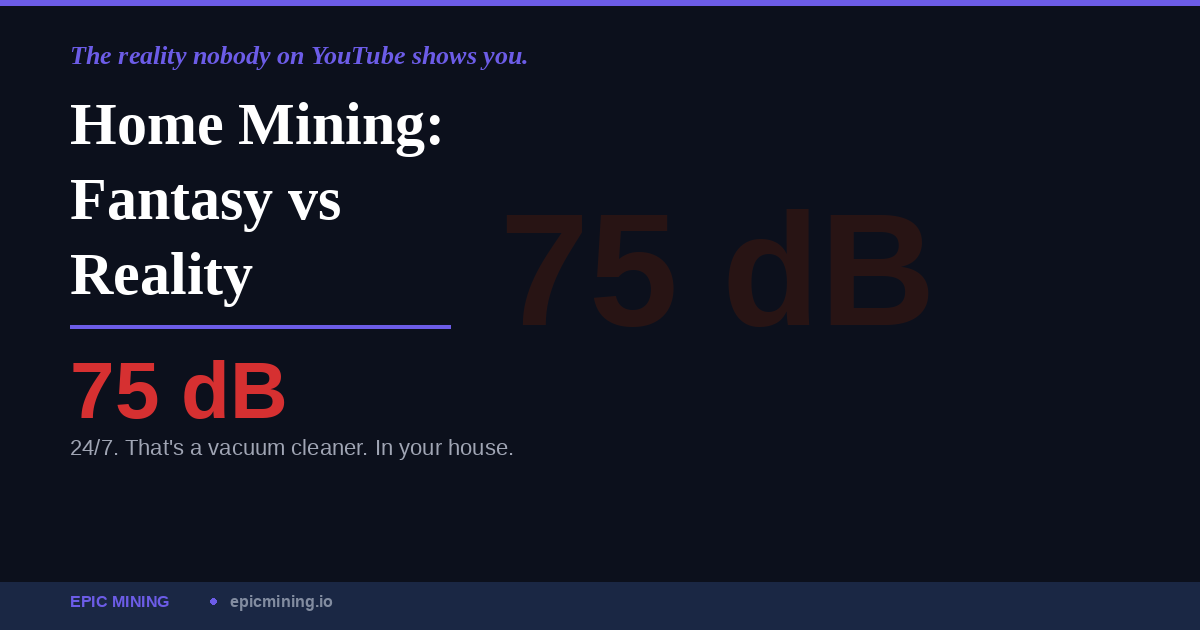
Home Mining: Fantasy vs Reality

YouTube makes home mining look easy. Here is the reality: the noise, the heat, the electricity bills, and whether it actually makes financial sense.

The Home Mining Fantasy

Scroll through YouTube and you will find hundreds of videos showing home mining setups. Clean garages, neat cable management, optimistic spreadsheets. What they usually leave out is that a single ASIC miner sounds like a vacuum cleaner running 24/7, produces as much heat as a space heater, and increases your electricity bill by $100 to $200 per month.

The fantasy is that you can set up a miner in your spare room and earn passive income. The reality is more complicated. Home mining can work for some people, but the challenges are significant and most people underestimate them.

The Real Challenges

Noise is the first problem. A modern ASIC runs at 75 decibels, roughly the level of a vacuum cleaner. That is tolerable in a garage or basement, but not in a living space. Your family will notice. Your neighbors might too.

Heat is the second problem. A 3,500 watt machine generates as much heat as a large space heater running constantly. In winter, that might heat your garage. In summer, it turns any enclosed space into a sauna and increases your cooling costs.

Electricity is the third and biggest problem. Most residential electricity rates are 10 to 16.5 cents per kWh. At those rates, your electricity cost alone consumes most or all of your mining revenue. The math only works at home if you have unusually cheap power.

When Home Mining Makes Sense

Home mining works if you have at least one of these: electricity under 8 cents per kWh, a detached space like a garage or workshop that can handle the noise and heat, or you live in a cold climate and can use the mining heat to offset heating costs.

Some people mine at home not primarily for profit but to acquire Bitcoin in a non KYC way, to learn about the technology hands on, or to contribute to network decentralization. These are valid reasons, but they are not the same as running a profitable operation.

The Better Alternative

For most people, hosted mining solves every problem that makes home mining difficult. You own the machine. It runs in a facility with 4 to 5 cent electricity. No noise in your house. No heat in your garage. No $200 surprise on your power bill.

You get institutional economics without institutional complexity. The machine produces Bitcoin 24/7 in a professional environment, and the BTC goes directly to your wallet. Here is how to get started in 7 days.

$0.12/kWh
average US residential electricity, nearly 3x the cost that makes mining profitable

Frequently Asked Questions

Can you mine Bitcoin at home?

Technically yes, but it is challenging. ASIC miners produce 75 decibels of noise and significant heat. Residential electricity rates of 10 to 16.5 cents per kWh make home mining marginally profitable at best. It works for some people with cheap power and dedicated space, but hosted mining is more practical for most.

How loud is a Bitcoin miner?

A modern ASIC miner runs at approximately 75 decibels, comparable to a vacuum cleaner running 24 hours a day. This is too loud for most living spaces and can be a nuisance even in a garage if you have close neighbors.

Is home mining profitable?

Only if your electricity rate is below 8 cents per kWh. At the average US residential rate of 12 cents, most of your mining revenue goes to electricity. At 15 cents, you are likely losing money. Hosted mining at 4 to 5 cents is significantly more profitable.

What is the best alternative to home mining?

Hosted mining. Your machine runs in a professional facility with cheap electricity, industrial cooling, and 24/7 monitoring. You own the hardware and keep the Bitcoin. No noise, no heat, no expensive power bills at home.

Keep Reading

Last updated: 2026-04-12

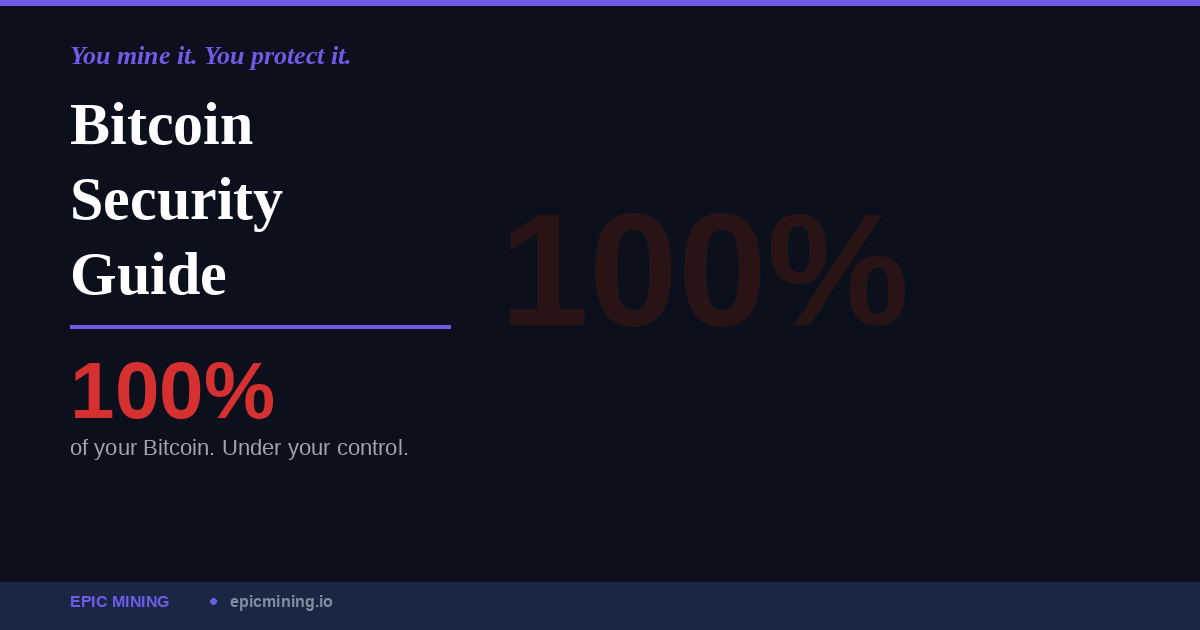
Bitcoin Security Guide: Protect What You Mine

Mining Bitcoin is the hard part. Losing it to poor security is the tragic part. Here is how to protect every satoshi you produce.

Rule #1: Not Your Keys, Not Your Coins

The foundational principle of Bitcoin security is self custody. If your Bitcoin sits on an exchange, you do not own it. The exchange owns it. You have an IOU. FTX, Mt. Gox, and dozens of smaller exchanges have proven this the hard way.

The entire value proposition of Bitcoin is that you can hold it without trusting anyone. If you leave it on an exchange, you give up that benefit.

Move your mined Bitcoin to a wallet you control as frequently as practical. Daily, weekly, or at whatever threshold makes sense for your mining output.

Hardware Wallets: Your First Line of Defense

A hardware wallet is a small physical device that stores your Bitcoin private keys offline. Popular options include Ledger Nano X, Trezor Model T, and Coldcard. These devices cost $70 to $250 and are the single best investment in Bitcoin security.

Your private keys never leave the device. When you send Bitcoin, the transaction is signed inside the hardware wallet and then broadcast. Even if your computer is compromised, your Bitcoin is safe because the keys are isolated.

Set up your hardware wallet, write down the recovery seed phrase on paper, and store it in a secure location. Never type your seed phrase into a computer. Never photograph it. Never store it in a cloud service.

Multisig: For Serious Holdings

As your mining rewards accumulate, consider upgrading to a multisignature (multisig) setup. Multisig requires multiple private keys to authorize a transaction. A common setup is 2 of 3: three keys exist, and any two are required to move funds.

This protects against single points of failure. If one key is lost or stolen, your Bitcoin is still safe. You need a coordinated compromise of two separate keys to lose funds.

Multisig setups are offered by services like Unchained Capital, Casa, and can be configured manually with tools like Sparrow Wallet. For holdings above $50,000, multisig is strongly recommended.

Operational Security Best Practices

Do not tell people how much Bitcoin you hold. This seems obvious but is the most commonly violated rule. Mining naturally involves some disclosure (you buy machines, you have a hosting arrangement), but your total holdings should be private.

Use unique, strong passwords for every exchange and mining pool account. Enable two factor authentication everywhere. Use a dedicated email address for Bitcoin related accounts that is not used for anything else.

Be skeptical of anyone who contacts you about Bitcoin, especially if they know you mine. Phishing, social engineering, and targeted attacks are real threats. No legitimate service will ever ask for your seed phrase.

100%
of your Bitcoin should be under your direct control. Self custody is not optional, it is fundamental.

Frequently Asked Questions

What is the safest way to store Bitcoin?

A hardware wallet for smaller amounts and a multisig setup for larger holdings. The key principle is self custody: holding your own private keys rather than trusting an exchange or third party.

What is a hardware wallet?

A hardware wallet is a physical device that stores your Bitcoin private keys offline. It signs transactions without exposing keys to your computer. Popular options include Ledger, Trezor, and Coldcard.

What is multisig?

Multisig requires multiple private keys to authorize a Bitcoin transaction. A 2 of 3 setup means three keys exist and any two are needed. This protects against loss or theft of a single key.

Should I keep Bitcoin on an exchange?

No, not for long term storage. Exchanges can be hacked, go bankrupt, or freeze your account. Move mined Bitcoin to your own wallet as frequently as practical. Only keep small amounts on exchanges for active trading.

Keep Reading

Last updated: 2026-04-12