icon New mining location added: Finland More information

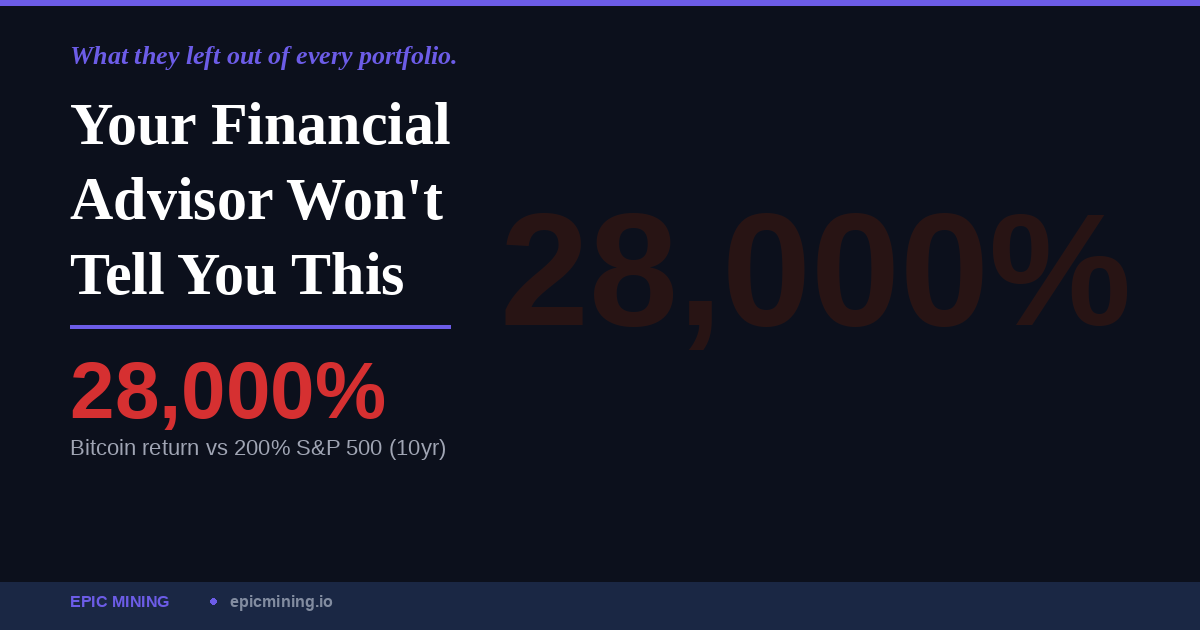
Your Financial Advisor Won’t Tell You This

The one asset class that outperformed everything in the last 15 years never made it into your portfolio. There is a reason for that.

The Asset Your Advisor Ignores

If your financial advisor managed $100,000 for you in 2015, they probably put you in a mix of stocks, bonds, and maybe some real estate. A good year returned 8% to 12%. Over a decade, that portfolio roughly doubled.

In the same period, Bitcoin went from $300 to over $80,000. That is a 26,000%+ return. It was the single best performing asset class of the last decade, and the decade before that. Yet most financial advisors never mentioned it, and still do not.

This is not because they are trying to protect you from risk. It is because their business model, their licensing, and their compliance structure do not accommodate Bitcoin. They cannot sell it, so they do not recommend it.

Why Traditional Finance Missed Bitcoin

Financial advisors earn commissions and management fees on the products they sell. Mutual funds, ETFs, annuities, insurance products. These are the tools they are trained on and compensated for.

Bitcoin does not fit into that model. There is no recurring management fee on a hardware wallet. There is no 1% annual advisory charge on self custodied BTC. When your advisor says “it is too risky,” what they often mean is “I cannot make money recommending it.”

The introduction of spot Bitcoin ETFs has started to change this, but most advisors still allocate 0% to Bitcoin. Meanwhile, Bitcoin keeps outperforming the portfolios they build.

The 60/40 Portfolio Is Broken

For decades, financial advisors recommended a 60% stocks and 40% bonds split. It was considered the gold standard of conservative investing. In the last five years, that model has been crushed.

Bonds lost significant value as interest rates rose. Stocks became increasingly concentrated in a handful of tech companies. The diversification that 60/40 was supposed to provide stopped working when both asset classes moved in the same direction.

Adding even a small Bitcoin allocation, just 2% to 5% of a portfolio, has historically improved risk adjusted returns. Multiple studies from Fidelity and ARK Invest have confirmed this. Your advisor likely knows this data exists. They just cannot act on it.

What Smart Money Is Actually Doing

While retail financial advisors tell clients to stay away from Bitcoin, the world’s largest institutions are buying it. BlackRock launched a Bitcoin ETF. Fidelity offers Bitcoin custody. MicroStrategy holds over 200,000 BTC on its balance sheet.

Nations are building strategic Bitcoin reserves. The smart money is not debating whether Bitcoin has value. They are debating how much to accumulate and how fast. The question is no longer “should I own Bitcoin” but “what is the best way to acquire it.”

One answer is producing it below market price through mining.

Producing Bitcoin Instead of Buying It

Your advisor will never suggest this: instead of buying Bitcoin at market price, you can produce it at a discount through mining.

A Bitcoin miner converts electricity into BTC 24 hours a day. At hosted facilities with institutional power rates, the cost to produce one Bitcoin is significantly below market price. You are not trading. You are manufacturing an asset at below retail cost.

This is how the largest Bitcoin holders in the world operate. They do not buy on exchanges. They mine.

26,000%+
Bitcoin’s return over the last decade vs ~200% for the S&P 500

Frequently Asked Questions

Why don’t financial advisors recommend Bitcoin?

Most advisors earn commissions and fees on traditional products like mutual funds, ETFs, and insurance. Bitcoin does not fit into their compensation model. They cannot charge a recurring management fee on self custodied Bitcoin, so they have little financial incentive to recommend it.

Is a 60/40 portfolio still a good strategy?

The traditional 60/40 stocks and bonds portfolio has underperformed in recent years. When interest rates rose, both stocks and bonds dropped simultaneously, breaking the diversification the model relies on. Multiple studies show that adding a small Bitcoin allocation of 2% to 5% improves risk adjusted returns.

How much Bitcoin should I have in my portfolio?

Research from Fidelity and ARK Invest suggests that a 2% to 5% Bitcoin allocation in a diversified portfolio has historically improved returns without significantly increasing risk. Some investors with higher risk tolerance allocate 10% or more. Your ideal allocation depends on your time horizon and goals.

Is it too late to invest in Bitcoin?

People have asked this question at every price point in Bitcoin’s history, from $1 to $80,000. Bitcoin’s market cap is still a fraction of gold, real estate, or global equities. If Bitcoin captures even a small percentage of these markets, the current price is still early.

Keep Reading

Last updated: 2026-04-12

How to Start Bitcoin Mining in 7 Days

This is the checklist. Follow it step by step and you will have a Bitcoin miner running and producing BTC within one week. No technical background needed.

Day 1 to 2: Decide Your Setup

You have two paths. Path A: Hosted mining (recommended for most people). You buy a machine and a hosting provider installs and manages it. No noise, no heat, institutional power rates. Path B: Home mining. You set up and run the machine yourself. Only practical if you have cheap electricity and a space that can handle 75 dB of constant noise.

For this guide, we will focus on Path A because it is the fastest, simplest, and most profitable path for most people. Contact a hosting provider, discuss machine options, and choose your miner.

Day 2 to 3: Purchase Your Miner

Choose a current generation ASIC. The Antminer S21 series and Whatsminer M60 series are the leading options in 2026. Budget $3,000 to $8,000 depending on the model.

Buy from your hosting provider (many offer packages) or from an authorized dealer. Verify the machine is new and comes with a manufacturer warranty. Pay and confirm delivery to the hosting facility.

Day 3 to 4: Set Up Your Bitcoin Wallet

You need a wallet to receive your mined Bitcoin. For long term holdings, use a hardware wallet (Ledger, Trezor, or Coldcard). For initial setup, a reputable software wallet like BlueWallet or Sparrow works fine.

Write down your seed phrase on paper. Store it in a secure location. Never share it with anyone. Never store it digitally. This seed phrase is the master key to your Bitcoin.

Day 4 to 5: Configure Your Mining Pool

Your hosting provider may handle this, but you will need to choose a mining pool. Major pools include Foundry USA, ViaBTC, F2Pool, and Antpool. Each has slightly different fee structures and payout methods.

Provide your pool information and wallet address to your hosting provider. They will configure the machine to mine to your pool and send rewards to your wallet.

Day 5 to 7: Machine Installation and First Bitcoin

The hosting facility receives your machine, inspects it, installs it in their facility, connects it to power and internet, and begins mining. You will receive a monitoring dashboard to track your machine’s performance.

Within 24 to 48 hours of installation, you will start seeing Bitcoin deposited into your wallet. That is it. You are now a Bitcoin miner producing BTC 24 hours a day.

From here, your job is simple: monitor your machine’s uptime and revenue, decide on your accumulation or selling strategy, and let the machine do its work.

7 Days
from first contact to first Bitcoin in your wallet. That is all it takes to start producing.

Frequently Asked Questions

How much does it cost to start Bitcoin mining?

A new ASIC miner costs $3,000 to $8,000. First month hosting is typically $100 to $200. Total startup cost ranges from roughly $3,500 to $8,500 depending on the machine you choose.

Do I need technical knowledge to start mining?

No. Hosted mining providers handle all technical setup including installation, power, cooling, pool configuration, and maintenance. You need a Bitcoin wallet and a decision on which machine to buy.

How quickly will I start earning Bitcoin?

Within 24 to 48 hours of your machine being installed at a hosting facility, you will start receiving Bitcoin to your wallet. Daily payouts are standard with most mining pools.

Can I start mining with just one machine?

Absolutely. One machine is the most common starting point. It produces Bitcoin at the same cost per unit as a facility with thousands of machines. Start with one, verify the economics, and scale from there.

What is the best mining machine for beginners?

The Antminer S21 series offers a good balance of efficiency and price. It is widely available, well supported, and compatible with all major hosting providers. Your hosting provider can also recommend specific models.

Keep Reading

Last updated: 2026-04-12

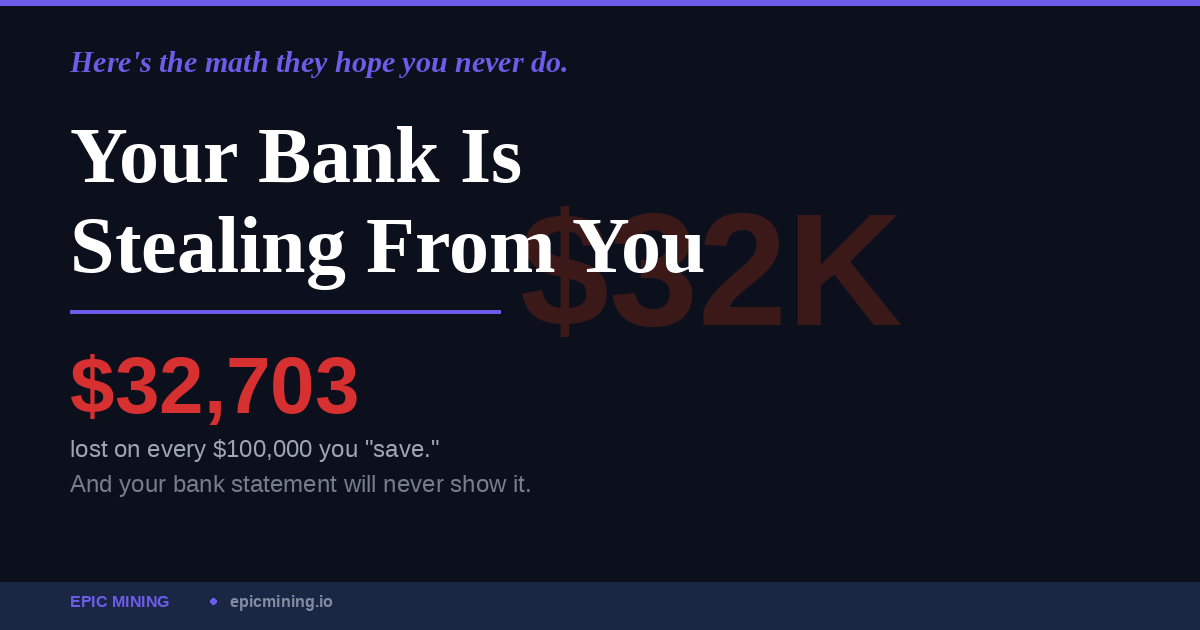
Your Bank Is Stealing From You (Here’s the Math)

Your savings account is not safe. It is actively losing value. Here is the math.

The Inflation Tax Nobody Talks About

Every year your money sits in a savings account, it buys less. Not because prices are going up, but because the value of your currency is going down. Central banks target 2% inflation as official policy. That means every dollar you saved last year is designed to be worth 2% less this year.

Your bank pays you somewhere between 0.5% and 2% interest. If inflation runs at 2% and your bank pays 1.5%, you lose 0.5% of your purchasing power every single year. That gap might sound small. Over 10 years, it compounds into a loss of $32,703 on every $100,000 you hold in cash.

Nobody shows you this number on your bank statement. The balance goes up by a few dollars each month, so it feels like your money is growing. But what that balance can actually buy is shrinking, quietly, every single day.

The Purchasing Power Erosion Table

Year $100,000 in Savings (1.5% APY) What $100K Buys (2% Inflation) Real Loss
2016 $100,000 $100,000 $0
2018 $103,022 $104,060 ($1,038)
2020 $106,136 $108,243 ($2,107)
2022 $109,344 $112,551 ($3,207)
2024 $112,649 $116,986 ($4,337)
2026 $116,054 $121,899 ($5,845)

Why Your Bank Statement Lies to You

Your bank statement shows your nominal balance. It never shows your real balance, which is what your money can actually purchase. If you deposited $100,000 ten years ago and your bank paid 1.5% interest, your statement shows roughly $116,054 today. That looks like a win.

But $100,000 worth of goods in 2016 now costs approximately $121,899. Your real purchasing power did not grow. It shrank by nearly $6,000. The bank made money lending your deposits. You lost money sitting in them.

This is not a bug in the system. It is the system. Central banks target inflation because it makes government debt cheaper to repay over time. The cost of that policy is paid by everyone holding cash.

What If You Had Stored Value in Bitcoin Instead?

Bitcoin has a fixed supply of 21 million coins. No central bank can print more. No government can inflate it away. Over any four year holding period in Bitcoin’s history, it has outperformed cash in a savings account.

Asset 2016 Value 2026 Value Real Return
Savings Account (1.5%) $100,000 $116,054 ($5,845 real loss)
S&P 500 $100,000 $230,000 +$108,101 real
Gold $100,000 $165,000 +$43,101 real
Bitcoin $100,000 $12,800,000+ +$12,678,101 real

The volatility is real. Bitcoin drops 30% to 50% in bear markets. But if your time horizon is four years or longer, the math has always favored Bitcoin over cash.

You Do Not Have to Buy Bitcoin at Market Price

Most people buy Bitcoin on an exchange at whatever the current price is. But there is another way. Bitcoin mining lets you produce Bitcoin below market price by converting electricity into BTC.

At facilities running 6 to 7 cents per kWh, a current generation miner produces Bitcoin at a cost well below what you would pay on Coinbase or Kraken. Instead of buying at retail, you are producing at wholesale.

You do not need to build a facility or manage hardware yourself. Hosted mining gives you access to institutional electricity rates and professional maintenance. You own the machine. You keep the Bitcoin.

$32,703
lost in purchasing power on $100,000 held in a savings account over 10 years

Frequently Asked Questions

How much money do you lose to inflation each year?

At the official target of 2% inflation, $100,000 in savings loses roughly $2,000 in purchasing power per year. Over 10 years, that same $100,000 buys what $82,000 would have bought when you deposited it. Real inflation on everyday costs like groceries, rent, and energy often runs between 5% and 8%, making the actual loss significantly higher.

Does a savings account protect against inflation?

No. Most savings accounts pay between 0.5% and 2% interest. If inflation runs at 2% and your bank pays 1.5%, you lose 0.5% of your purchasing power per year. Your account balance grows, but what that balance can actually buy shrinks. Over 20 years, this gap compounds into a loss of 15% to 20% in real purchasing power.

Why do central banks target 2% inflation?

Central banks target 2% inflation because it makes government debt cheaper to repay over time. When a government borrows money today and pays it back in future dollars that are worth less, the real cost of that debt decreases. Inflation is the mechanism that allows governments to borrow beyond their means and quietly reduce the burden by devaluing the currency you hold.

Is Bitcoin a better store of value than a savings account?

Over any 4+ year period in Bitcoin’s history, holding Bitcoin has outperformed holding cash in a savings account. Bitcoin has a fixed supply of 21 million coins, which means no central bank can print more of it. Bitcoin is volatile in the short term, but the case for it as a store of value gets stronger the longer your time horizon.

Can I mine Bitcoin instead of buying it?

Yes. Bitcoin mining means running specialized hardware that earns Bitcoin by processing transactions on the network. Instead of buying Bitcoin at market price, you produce it at your cost of electricity. In hosted facilities running at 6 to 7 cents per kWh, you can produce Bitcoin at a cost well below market price.

Keep Reading

Last updated: 2026-04-12